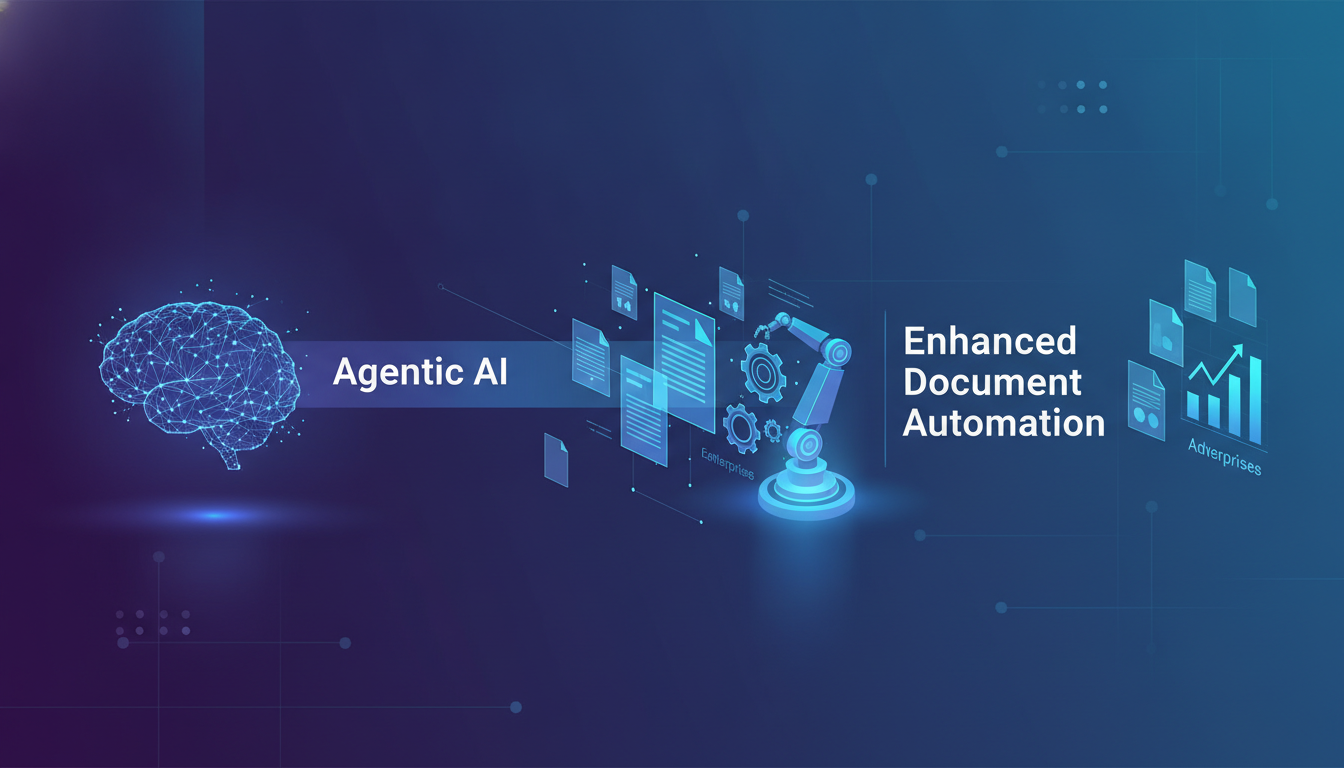
Understanding the Advantages of Agentic OCR for Enhanced Document Automation in Enterprises
Hook
In the fast-paced world of enterprise operations, document discrepancies can lead to costly errors and inefficiencies. Traditional OCR systems often fall short when document layouts change, leading to missed subtotals or incorrect data extraction. This is a common problem faced by enterprises relying on outdated document automation methods.
Answer-first summary
Agentic OCR offers a significant advancement over traditional OCR by incorporating reasoning, self-correction, and adaptive model selection into document processing. Unlike traditional methods, which rely on static templates and are prone to errors when document formats change, Agentic OCR adapts to new layouts and ensures accuracy through iterative validation. This approach is particularly beneficial for enterprises in sectors like legal, healthcare, and financial services, where precise document handling is crucial.
What makes Agentic OCR different from traditional OCR?
Traditional OCR systems primarily focus on converting scanned images into machine-encoded text through pattern matching. This method is effective only when document formats remain consistent. However, in dynamic enterprise environments, document layouts often vary, leading to decreased accuracy. Agentic OCR addresses this limitation by employing a goal-oriented reasoning approach. It can automatically recognize document types, understand layout changes, and adapt without the need for manual reconfiguration. This adaptability ensures that enterprises can maintain high accuracy levels even as document formats evolve over time.
How does Agentic OCR enhance document workflows?
Agentic OCR extends beyond simple text extraction by integrating reasoning capabilities into the document processing pipeline. This allows the system to validate extracted data against business logic and detect inconsistencies before they propagate through other systems. For instance, in invoice processing, Agentic OCR can compare extracted totals with purchase orders and flag discrepancies for review. This proactive approach reduces the need for manual intervention and enhances the efficiency of document workflows. By owning the entire document workflow, Agentic OCR minimizes errors and ensures that human involvement is only required when necessary.
What are the key components of Agentic OCR?
Agentic OCR relies on several key components to deliver its enhanced capabilities. Multimodal language models serve as the reasoning layer, enabling the system to interpret both text and images as meaningful data. Visual grounding links extracted data to its original location on the document, providing traceability and auditability. Document type recognition is performed automatically, allowing the system to adapt to new document formats without manual setup. The agentic loop ties these components together, ensuring that each document is processed with the appropriate model and that any errors are corrected before data is passed to other systems.
Why is Agentic OCR particularly beneficial for certain industries?
Industries such as legal, healthcare, and financial services stand to gain significant benefits from Agentic OCR due to their reliance on precise document handling. In legal settings, Agentic OCR can streamline contract review by extracting and analyzing key clauses, identifying high-risk terms, and mapping them to specific pages with source citations. In healthcare, it can automate the processing of medical forms and ensure compliance with regulatory standards. Financial services can benefit from accurate invoice processing and fraud detection through real-time validation of financial documents. The ability to adapt to diverse document types and ensure data accuracy makes Agentic OCR an invaluable tool for these sectors.
What this means for your organization
Implementing Agentic OCR can transform your organization's document processing capabilities. By reducing reliance on manual intervention and minimizing errors, it enhances operational efficiency and accuracy. The adaptability of Agentic OCR to various document formats ensures that your systems remain robust even as your document types evolve. Additionally, by automating validation and exception handling, it frees up human resources to focus on higher-value tasks, ultimately contributing to cost savings and improved productivity. Enterprises looking to modernize their document automation strategies should consider integrating Agentic OCR solutions into their operations.
FAQ
What is the primary difference between traditional OCR and Agentic OCR? Traditional OCR relies on pattern matching and is template-dependent, while Agentic OCR employs goal-oriented reasoning and adapts to new document formats without manual setup.
How does Agentic OCR handle errors differently from standard OCR systems? Agentic OCR incorporates a self-correction loop that identifies and corrects errors before data is passed to other systems, reducing the need for manual review.
Can Agentic OCR be integrated with existing enterprise systems? Yes, Agentic OCR can be integrated with existing enterprise systems such as ERPs and CRMs to automate document workflows and enhance data accuracy.
Is Agentic OCR suitable for small businesses or only large enterprises? While Agentic OCR offers significant advantages for large enterprises, its scalability and adaptability make it suitable for small and medium-sized businesses looking to improve document automation.
Closing call-to-action
To explore how Agentic OCR can enhance your document automation processes, contact us today and discover tailored solutions for your enterprise needs.
Saksham Gupta
Founder & CEOSaksham Gupta is the Co-Founder and Technology lead at Edubild. With extensive experience in enterprise AI, LLM systems, and B2B integration, he writes about the practical side of building AI products that work in production. Connect with him on LinkedIn for more insights on AI engineering and enterprise technology.