AI Agents vs AI Assistants: Choosing the Right Path for Your Workflow
In the rapidly evolving landscape of artificial intelligence, the terms "AI agents" and "AI assistants" often intermingle, leading to confusion about their distinct roles and capabilities. While both are built on the same foundational large language models (LLMs), like GPT, Claude, or Gemini, the way they integrate and function within systems can significantly differ. Understanding these differences is crucial for choosing the right path for your workflow.
Architectural Foundations
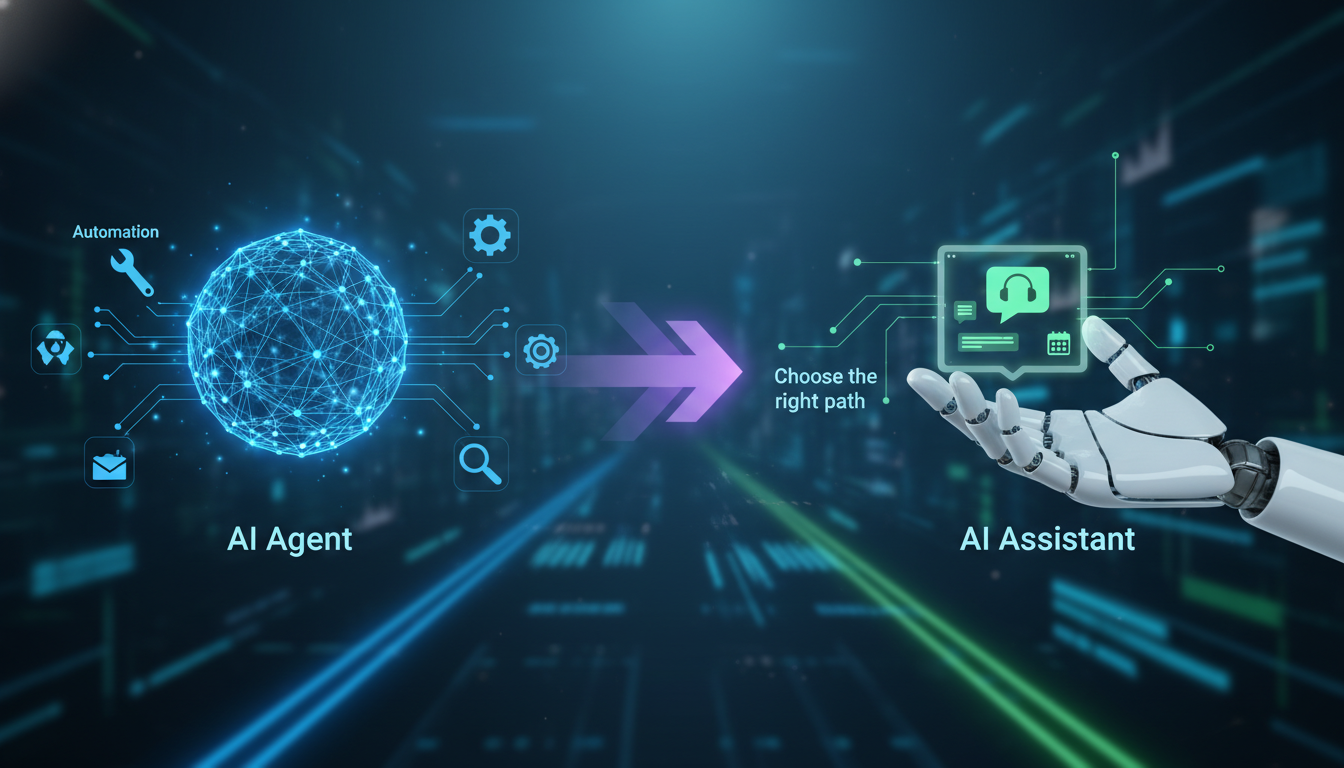
At the core, both AI agents and AI assistants leverage LLMs to process information and generate responses. However, they diverge in their architectural application. AI assistants are typically prompt-driven, designed to facilitate interaction through conversation, making them ideal for tasks like writing, summarizing, and real-time analysis. They excel in enhancing human productivity by assisting in specific, often isolated, tasks.
Conversely, AI agents are goal-driven, built for execution across multiple systems. These autonomous systems use orchestration, memory, and tool integration to execute complex, multi-step workflows. AI agents don't just assist in tasks—they complete them, enabling end-to-end automation that can significantly streamline processes across an organization.
Interaction vs. Execution
The primary distinction between AI assistants and AI agents lies in their approach to interaction and execution. AI assistants serve as the point of engagement, interacting with users to provide information and support. They respond to user prompts and work within the confines of a single task or conversation, making them reactive in nature.
AI agents, on the other hand, act as the point of action. They are proactive, capable of initiating actions based on triggers such as system events or scheduled tasks. This autonomy allows them to manage workflows that involve reading data from one system and writing updates to another, thus facilitating seamless integration and execution across various platforms.
Use Cases and Integration
Choosing between an AI assistant and an AI agent often depends on your specific use case and workflow requirements. If your needs are centered around improving individual productivity through better engagement, an AI assistant may suffice. These systems are typically easier to deploy, requiring only basic integration with existing chat interfaces and LLM APIs.
However, if your workflow demands automation that spans multiple systems or involves complex dependency chains, an AI agent is the better choice. These systems require more intricate integration with CRMs, ERPs, and other enterprise tools, but they offer the advantage of executing entire workflows autonomously.
The Hybrid Approach
In many enterprise environments, a hybrid approach that utilizes both AI assistants and AI agents can offer the most comprehensive solution. In such setups, AI assistants handle the interaction layer, engaging with users to gather information and initiate tasks. They then pass these tasks to AI agents, which handle the execution layer, completing the tasks by interacting with various systems and tools.
This separation of roles ensures that each system is optimized for its specific function, making the overall architecture more scalable and efficient. For example, a customer service scenario might involve an AI assistant managing initial customer interaction, while an AI agent processes refunds or updates customer records in backend systems.
Conclusion
The decision between deploying an AI assistant or an AI agent should be guided by the specific needs of your workflow. If the primary goal is enhancing interaction and supporting human tasks, AI assistants are the way to go. However, for workflows requiring robust automation and system integration, AI agents are indispensable. Often, a combination of both technologies provides the best results, offering a balanced approach to interaction and execution within enterprise systems.
In the end, understanding the unique capabilities and roles of AI agents and assistants is key to leveraging their full potential in your organization. By aligning your AI strategy with your workflow requirements, you can ensure that your systems are not only efficient but also adaptable to future technological advancements.
Saksham Gupta
Founder & CEOSaksham Gupta is the Co-Founder and Technology lead at Edubild. With extensive experience in enterprise AI, LLM systems, and B2B integration, he writes about the practical side of building AI products that work in production. Connect with him on LinkedIn for more insights on AI engineering and enterprise technology.