Evaluating the Limitations of Traditional OCR for Scanned PDFs and How to Overcome Them
Hook
In today's digital landscape, enterprises are increasingly reliant on document processing for efficient operations. However, when dealing with scanned PDFs, traditional OCR (Optical Character Recognition) systems often fall short, leading to data inaccessibility and processing errors. These limitations can hinder your business's ability to automate workflows and extract valuable insights from documents.
Answer-first summary
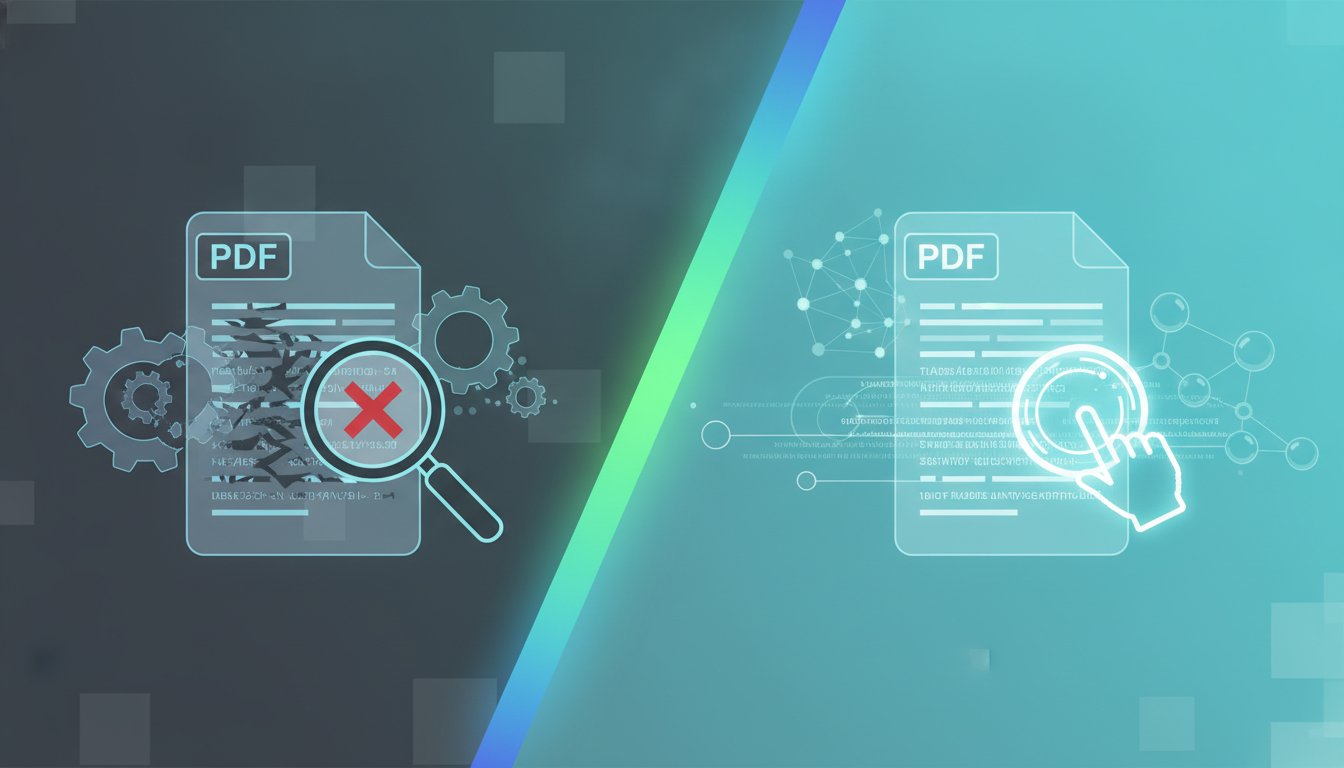
Traditional OCR systems struggle with complex layouts, multi-column texts, and embedded tables in scanned PDFs, often resulting in unusable text outputs. To overcome these challenges, enterprises can leverage advanced document AI solutions that integrate layout parsing and high-accuracy character recognition. These solutions enhance text extraction accuracy, making documents machine-readable and ready for downstream processing.
What are the limitations of traditional OCR systems?
Traditional OCR systems, while effective for simple text extraction, encounter significant challenges with complex document layouts. These systems primarily focus on recognizing individual characters without understanding the document's structural hierarchy. This limitation is pronounced in multi-column documents, tables, and charts, where text order and structural context are crucial. For instance, in financial reports or legal documents, traditional OCR might collapse columns into a single text stream, disrupt table formats, or ignore embedded images. This results in outputs that are technically readable but lack usability for automated processing.
Moreover, traditional OCR systems often fail with handwritten text, stamps, or documents with mixed languages, leading to recognition errors or gibberish outputs. The inability to handle these complexities necessitates manual post-processing, increasing time and cost. Enterprises seeking to streamline document workflows must consider these limitations when evaluating OCR solutions.
How does layout complexity affect OCR performance?
The core challenge with traditional OCR systems lies in their inability to parse document layouts accurately. These systems treat documents as flat grids of characters, ignoring the spatial and hierarchical context of text elements. For example, a multi-page legal document with footnotes, headers, and embedded tables requires not just text recognition, but also an understanding of how these elements relate to each other.
Without layout parsing, OCR outputs may present text in a disordered sequence, making it challenging to extract meaningful insights or automate data entry tasks. In industries like finance, where precision is paramount, such disordered outputs can lead to significant inaccuracies and compliance risks. Enterprises must look for solutions that integrate both character recognition and layout parsing to ensure text outputs are both accurate and contextually meaningful.
What solutions can overcome traditional OCR limitations?
To address the shortcomings of traditional OCR, enterprises can adopt advanced document AI solutions that incorporate layout parsing and machine learning techniques. These solutions are designed to recognize and interpret complex document structures, ensuring accurate text extraction and preserving the document's original layout.
For instance, using OCR and document AI services provided by EdubildAI, businesses can convert scanned PDFs into searchable and editable formats with high precision. These solutions utilize AI models trained to handle diverse document types, including multi-column layouts and embedded tables, reducing the need for manual intervention.
Additionally, enterprises can leverage on-premise deployment options for sensitive documents, ensuring data privacy and compliance with industry regulations. By investing in comprehensive document AI solutions, businesses can enhance their document processing capabilities and drive operational efficiency.
What are the benefits of high-accuracy character recognition?
High-accuracy character recognition transforms scanned documents into machine-readable formats with minimal errors. This capability is crucial for enterprises that depend on accurate data extraction for decision-making and process automation. With advanced OCR technologies, businesses can achieve higher accuracy rates, reducing the time and resources spent on manual data correction.
Moreover, high-accuracy OCR supports accessibility by making documents compatible with screen readers, essential for visually impaired users. This not only enhances document usability but also aligns with regulatory requirements for accessibility. For enterprises, investing in high-accuracy OCR technologies means improved data integrity and enhanced workflow automation, directly impacting productivity and cost-efficiency.
Implementation considerations
When implementing advanced document AI solutions, enterprises must consider several factors to maximize benefits. First, evaluate the types of documents commonly processed and identify specific OCR challenges, such as layout complexity or language diversity. Next, assess the integration capabilities of the chosen solution with existing enterprise systems to ensure seamless data flow.
Enterprises should also consider the deployment model—whether on-premise or cloud-based—to align with data security policies and compliance requirements. For industries dealing with sensitive information, on-premise deployment may offer greater control and security. Lastly, ongoing training and support from solution providers, like EdubildAI, are crucial for maintaining system performance and adapting to evolving document processing needs.
FAQ
What is the difference between traditional and advanced OCR systems? Traditional OCR systems focus solely on character recognition, often struggling with complex layouts. Advanced OCR systems integrate layout parsing and machine learning to accurately interpret document structures, enhancing text extraction accuracy.
Why is layout parsing important in OCR? Layout parsing is crucial for understanding the spatial relationships between text elements in a document. It ensures that text is extracted in the correct order and context, which is essential for accurate data processing and analysis.
Can advanced OCR systems handle handwritten text? Yes, advanced OCR systems equipped with machine learning models can handle handwritten text with higher accuracy than traditional systems. They are trained on diverse datasets to improve recognition capabilities across different document types.
What deployment options are available for document AI solutions? Document AI solutions can be deployed on-premise or in the cloud, depending on enterprise needs. On-premise deployment offers greater data control and security, while cloud-based solutions provide scalability and ease of access.
Closing call-to-action
To explore how advanced document AI solutions can enhance your enterprise's document processing capabilities, contact EdubildAI today.
Saksham Gupta
Founder & CEOSaksham Gupta is the Co-Founder and Technology lead at Edubild. With extensive experience in enterprise AI, LLM systems, and B2B integration, he writes about the practical side of building AI products that work in production. Connect with him on LinkedIn for more insights on AI engineering and enterprise technology.