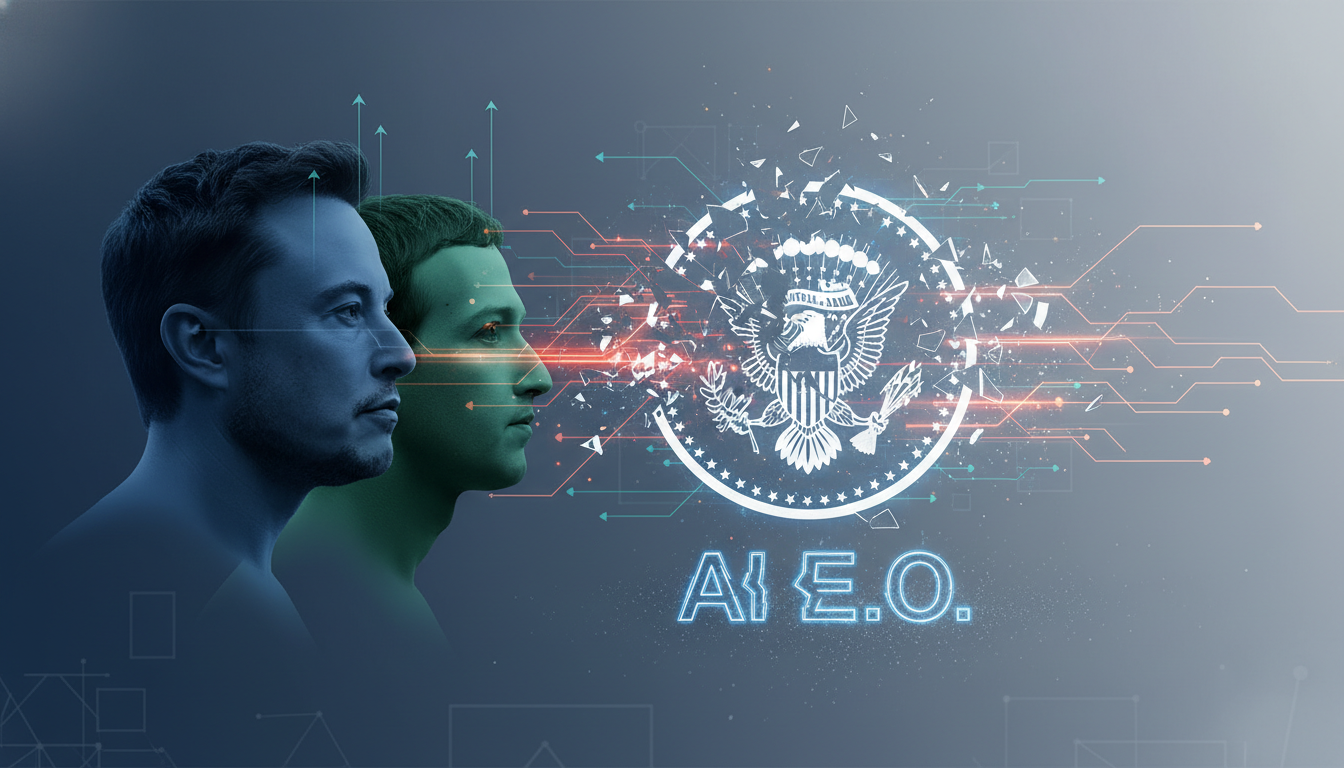
Musk and Zuckerberg's Last-Minute Lobby: The Collapse of Trump's AI Executive Order
In a surprising turn of events that underscores the complex dynamics between technology leaders and government policy, US President Donald Trump recently withdrew a planned executive order on artificial intelligence (AI). The order, which had faced numerous delays, was intended to establish a voluntary framework for AI developers to collaborate with federal agencies. However, it was scrapped following direct appeals from influential figures in the tech industry, including Elon Musk and Mark Zuckerberg.
The Lobbying Power of Tech Titans
The decision to abandon the executive order was reportedly made after a series of discussions between Trump and several key players in the tech industry. Elon Musk, CEO of xAI, along with Meta's Mark Zuckerberg and venture capitalist David Sacks, engaged in late-night talks with Trump. These discussions emphasized the potential negative impact of the order on America's competitive advantage over China in the AI sector.
The planned executive order was not intended to impose strict regulations but rather to offer a voluntary mechanism for AI developers to engage in security reviews with federal agencies. Despite the lack of mandatory requirements, the order was perceived as too restrictive by some industry leaders who are wary of any potential impediments to innovation.
The Implications of a Regulatory Vacuum
Trump's reluctance to proceed with the executive order leaves the United States without a comprehensive national AI policy. Current governance is a patchwork of executive orders, agency guidelines, and voluntary agreements, which lack the coherence and strength of a unified legislative framework.
The absence of robust national AI legislation contrasts sharply with the approach taken by China. Beijing has been proactive in developing a legislative work plan focused on AI governance, highlighting its commitment to establishing a comprehensive regulatory framework. This disparity raises concerns about the US's ability to maintain its leadership position in AI innovation and governance.
Industry Influence on Policy
The abandonment of the executive order highlights the significant influence that a small group of tech industry leaders wields over US AI policy. Figures like Musk and Zuckerberg, whose companies have vested interests in an open regulatory environment, are able to shape policy decisions at the highest levels of government.
This influence is further complicated by the fact that some companies, like OpenAI, are pursuing state-level AI regulations with White House support, despite the administration's previous discouragement of state-level AI laws. This dual approach to AI governance suggests a lack of clear policy direction and coherence within the administration.
The Global AI Governance Race
The rationale provided by Trump for scrapping the executive order was to protect the US's technological lead over China. This reasoning is consistent with the administration's broader strategy to prioritize national security and economic competitiveness in AI policy decisions.
However, this focus on competition with China may overlook the importance of establishing a robust governance framework for AI. As AI technologies become more advanced and capable of autonomous action, the need for effective regulation that balances innovation and safety becomes increasingly critical.
China's proactive stance on AI governance, including the establishment of internal ethics review committees for AI companies, positions it as a potential leader in setting international standards for AI regulation. The US's current lack of comprehensive AI legislation could hinder its ability to influence global AI governance standards.
The Future of AI Regulation in the US
The recent events surrounding the proposed executive order reflect the ongoing tension between innovation and regulation in the AI sector. While industry leaders advocate for minimal regulatory interference to foster innovation, the need for a coherent governance framework that addresses safety and ethical concerns is undeniable.
As the US navigates these challenges, the role of influential tech leaders in shaping policy will likely continue to be a critical factor. The question remains whether the administration will be able to reconcile the competing demands of innovation, national security, and ethical governance in its AI policy framework.
In the absence of a comprehensive national strategy, the US risks falling behind in the global race to establish effective AI governance. Whether the lessons from this episode will lead to a more coherent and strategic approach to AI regulation in the future remains to be seen.
Saksham Gupta
Founder & CEOSaksham Gupta is the Co-Founder and Technology lead at Edubild. With extensive experience in enterprise AI, LLM systems, and B2B integration, he writes about the practical side of building AI products that work in production. Connect with him on LinkedIn for more insights on AI engineering and enterprise technology.