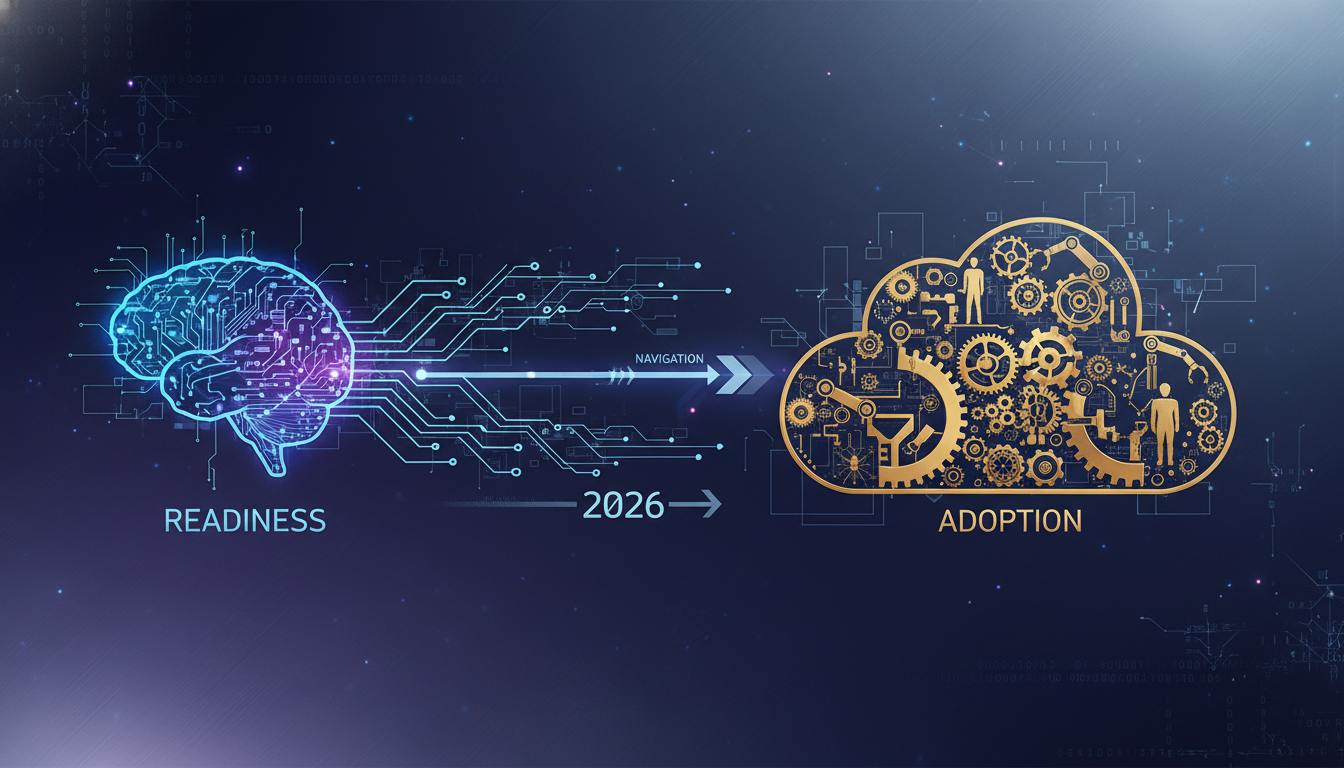
Navigating the AI Landscape: Key Differences Between Readiness and Adoption for Enterprises in 2026
As we navigate through 2026, the conversation around artificial intelligence (AI) in enterprises is shifting from sheer adoption to a more nuanced understanding of readiness. The rapid evolution of AI capabilities has pushed businesses to question not just how quickly they can adopt AI, but how prepared they are to scale and integrate these technologies meaningfully. This distinction between AI readiness and AI adoption is emerging as a pivotal factor for enterprise leaders to consider.
Why AI Readiness Is Crucial
The rush to adopt AI has created an environment where speed is mistakenly equated with success. Enterprises are often driven by pressure from boards, competitive forces, and market expectations to demonstrate quick wins through AI adoption. However, this eagerness can lead to strategic blind spots, where the lack of readiness results in fragmented implementations rather than cohesive transformation.
AI readiness is about the foundational preparedness of an organization to implement AI technologies effectively and sustainably. It involves strategic alignment, data maturity, governance frameworks, workforce capability, and risk management. Without addressing these elements, enterprises risk adopting technologies that they are not structurally prepared to scale.
The Difference Between AI Adoption and AI Readiness
AI adoption is a decision; it involves the deployment of technologies such as chatbots, predictive analytics, or generative AI assistants. These implementations can often be rapid, creating a false sense of technological advancement. However, AI readiness is an organizational condition that encompasses the maturity of underlying processes and systems required to support AI technologies.
Key Differences:
- Nature: AI adoption is a transactional process, while AI readiness is cumulative.
- Timeline: Adoption can be immediate, whereas readiness is a progressive journey.
- Focus: Adoption centers on technology deployment; readiness emphasizes capability maturity.
- Success Metric: Adoption is measured by implementation, readiness by business value.
- Risk: Adoption risks fragmentation, whereas readiness supports deliberate scaling.
- Ownership: Adoption is often IT-led, while readiness requires enterprise-wide engagement.
The Cost of Misunderstanding AI Readiness
Confusing readiness with adoption can lead to several organizational challenges. These include pilot overload, undefined return on investment, governance debt, tool redundancy, and employee distrust. These issues are often structural rather than technological, highlighting the importance of a well-thought-out readiness framework.
AI implementations that are not backed by robust data governance and quality frameworks tend to reveal, rather than create, organizational inefficiencies. Fragmented data, unclear ownership, and ambiguous processes become more pronounced as AI systems amplify existing organizational weaknesses.
The “We’ll Figure Governance Out Later” Trap
A common pitfall for enterprises is the belief that governance can be established post-implementation. While experimentation is crucial, unmanaged experimentation can result in organizational debt that hinders long-term success. Establishing governance frameworks, defining acceptable use cases, and setting risk thresholds are critical components of AI readiness that should precede widespread adoption.
What AI Readiness Looks Like
AI readiness is reflected in an organization’s ability to scale AI technologies responsibly and measurably. It involves:
- Strategic Alignment: Ensuring AI initiatives are directly linked to measurable business outcomes.
- Data Readiness: Maintaining high data quality and governance to support reliable AI outputs.
- Governance and Risk Management: Defining clear policies for AI use and accountability.
- Workforce Readiness: Equipping teams with the skills to effectively work alongside AI.
- Measurement Maturity: Establishing success metrics prior to implementation.
The Competitive Advantage of AI Readiness
In a landscape where AI technologies are becoming increasingly accessible, organizational maturity becomes the true differentiator. Enterprises that prioritize readiness develop governance maturity, cross-functional alignment, reliable data ecosystems, scaling discipline, and measurable ROI. These factors together create a sustainable competitive advantage that is difficult for competitors to replicate.
When AI Adoption Makes Strategic Sense
AI adoption should not be delayed indefinitely. Rather, it should be approached with a strategic sequence that ensures readiness before scaling. Organizations that understand their business outcomes, have reliable data foundations, clear governance, and defined scaling criteria are well-positioned to adopt AI in a way that delivers sustainable transformation.
For enterprises aiming to leverage AI effectively, focusing on readiness as a precursor to adoption will be crucial. This approach not only mitigates the risks associated with premature implementation but also maximizes the potential for AI to drive meaningful business value. As we move further into the AI-driven future, the question for enterprise leaders is shifting from how fast they can adopt AI to how confidently they can scale it across the organization.
Saksham Gupta
Founder & CEOSaksham Gupta is the Co-Founder and Technology lead at Edubild. With extensive experience in enterprise AI, LLM systems, and B2B integration, he writes about the practical side of building AI products that work in production. Connect with him on LinkedIn for more insights on AI engineering and enterprise technology.