Navigating the AI Landscape: Understanding the Distinction Between AI Agents and LLMs
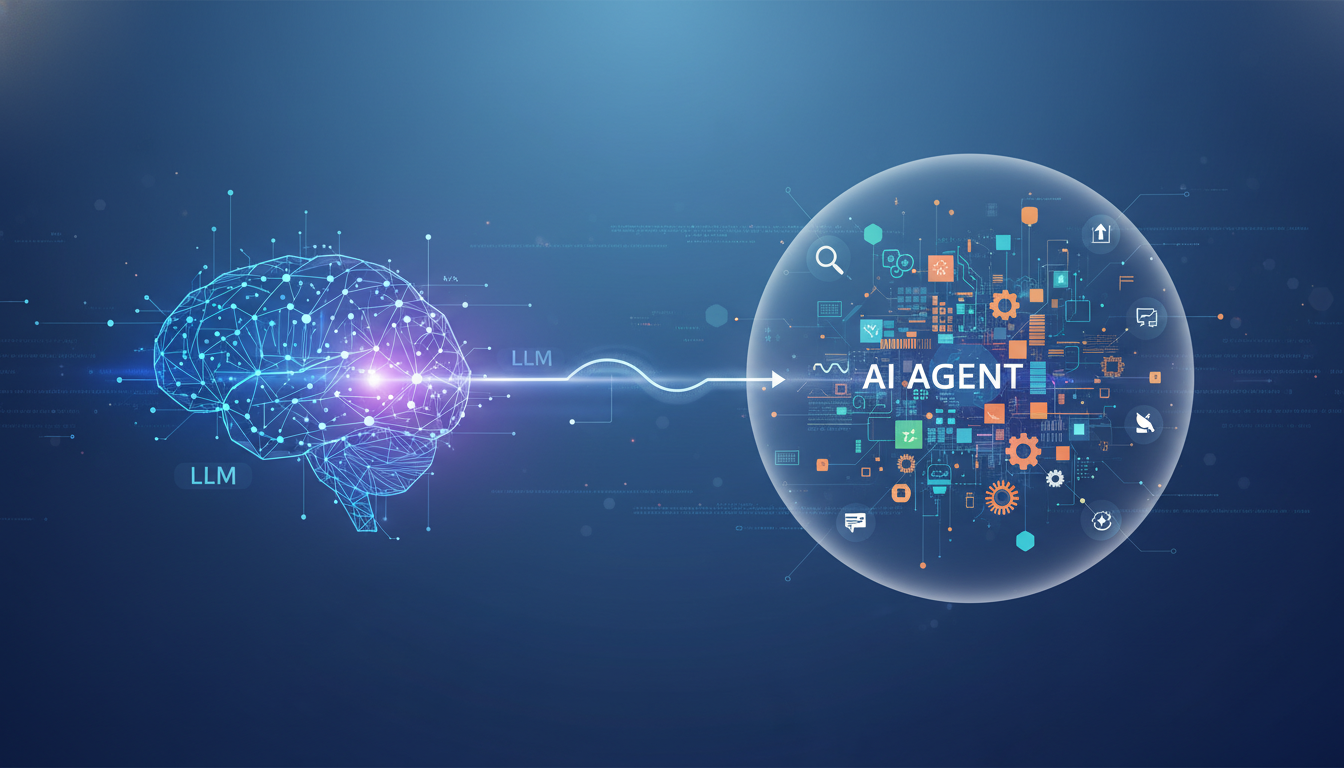
In the realm of artificial intelligence, the terms AI agents and large language models (LLMs) are often mentioned together, leading to confusion about their roles and differences. While they appear as competing technologies, the reality is that they serve complementary functions. An LLM acts as a reasoning engine, whereas an AI agent is a more comprehensive system built around an LLM, adding layers like orchestration, memory, planning, tool usage, and autonomous execution.
AI Agent vs LLM: The Architectural Comparison
The distinction between AI agents and LLMs lies in their architecture and capabilities. An LLM is primarily a foundation model adept at predicting the next token in a sequence based on learned data patterns. This makes it suitable for tasks like content generation, summarization, and Q&A. However, its interaction pattern is limited to a prompt-to-response flow without persistent memory or the ability to execute actions.
In contrast, an AI agent builds on the LLM by incorporating additional layers that enable it to plan multi-step tasks, interact with external systems, and maintain memory across sessions. This makes AI agents ideal for complex workflows that require interaction with multiple tools and continuous task execution.
Why Language Models Alone Aren’t Enough for Complex Business Workflows
LLMs, while powerful, have inherent limitations when it comes to handling complex business tasks. They lack memory across sessions, cannot execute actions, and are limited to single-step reasoning. This makes them unsuitable for workflows that require multi-step execution, cross-system orchestration, and persistent memory.
Failure Mode 1: No Memory Across Sessions
LLMs do not retain information beyond a session, leading to inefficiencies in scenarios where continuity is required. For instance, customer service interactions that span multiple sessions often require context retention that LLMs alone cannot provide.
Failure Mode 2: No Action Taking
While LLMs can identify and describe tasks, they cannot directly execute them. This is a significant gap in workflows where action-taking is essential, such as updating records or triggering workflows in external systems.
Failure Mode 3: Single-Turn Reasoning, Not Multi-Step Execution
LLMs excel in single-turn tasks but struggle with multi-step processes that require planning and coordination across various stages. This limitation is evident in tasks like customer churn analysis, which involves multiple interdependent steps.
When the LLM Alone Is Enough for Enterprises
Despite their limitations, there are scenarios where LLMs are entirely sufficient. These include self-contained tasks that do not require orchestration or memory, such as:
Scenario 1: Content Generation Tasks
Tasks that involve generating content, such as drafting emails or writing marketing copy, can be effectively handled by LLMs through well-designed prompts.
Scenario 2: Single-Turn Q&A Over Knowledge Bases
For retrieval-based question-answering systems, LLMs can efficiently provide responses using company or domain knowledge without needing an agent layer.
Scenario 3: Predictable, Bounded Tasks
LLMs are well-suited for structured tasks like translation or sentiment analysis, which have clearly defined inputs and outputs.
When Enterprises Genuinely Need the Agent Layer
Certain workflows necessitate the capabilities of an AI agent. Indicators include:
- Multi-System Workflows: Tasks requiring interaction with multiple systems or tools need the orchestration capabilities of an agent.
- Sequential Dependencies: Workflows with interdependent steps benefit from the planning and reasoning capabilities of an AI agent.
- Persistent Memory Needs: Processes that rely on historical context require an agent's ability to maintain memory across sessions.
- Exception Handling: Workflows with exceptions that require judgment benefit from an agent's multi-step evaluation capabilities.
- Proactive Execution: Systems that must operate independently, such as monitoring or anomaly detection, require the proactive behavior of an agent.
The Technical Stack: How Frameworks Build the Agent Layer
Building an AI agent involves integrating multiple layers beyond the foundation LLM. These include prompt engineering, orchestration, tool access, and memory management. Each layer adds specific capabilities, transforming the LLM from a mere language model into a robust agent capable of executing complex tasks.
Conclusion
The distinction between AI agents and LLMs is not about choosing one over the other but understanding their roles within a system. While LLMs suffice for straightforward, bounded tasks, AI agents are necessary for complex, multi-step workflows. By integrating the right layers, enterprises can leverage the full potential of AI to address their specific needs.
Saksham Gupta
Founder & CEOSaksham Gupta is the Co-Founder and Technology lead at Edubild. With extensive experience in enterprise AI, LLM systems, and B2B integration, he writes about the practical side of building AI products that work in production. Connect with him on LinkedIn for more insights on AI engineering and enterprise technology.