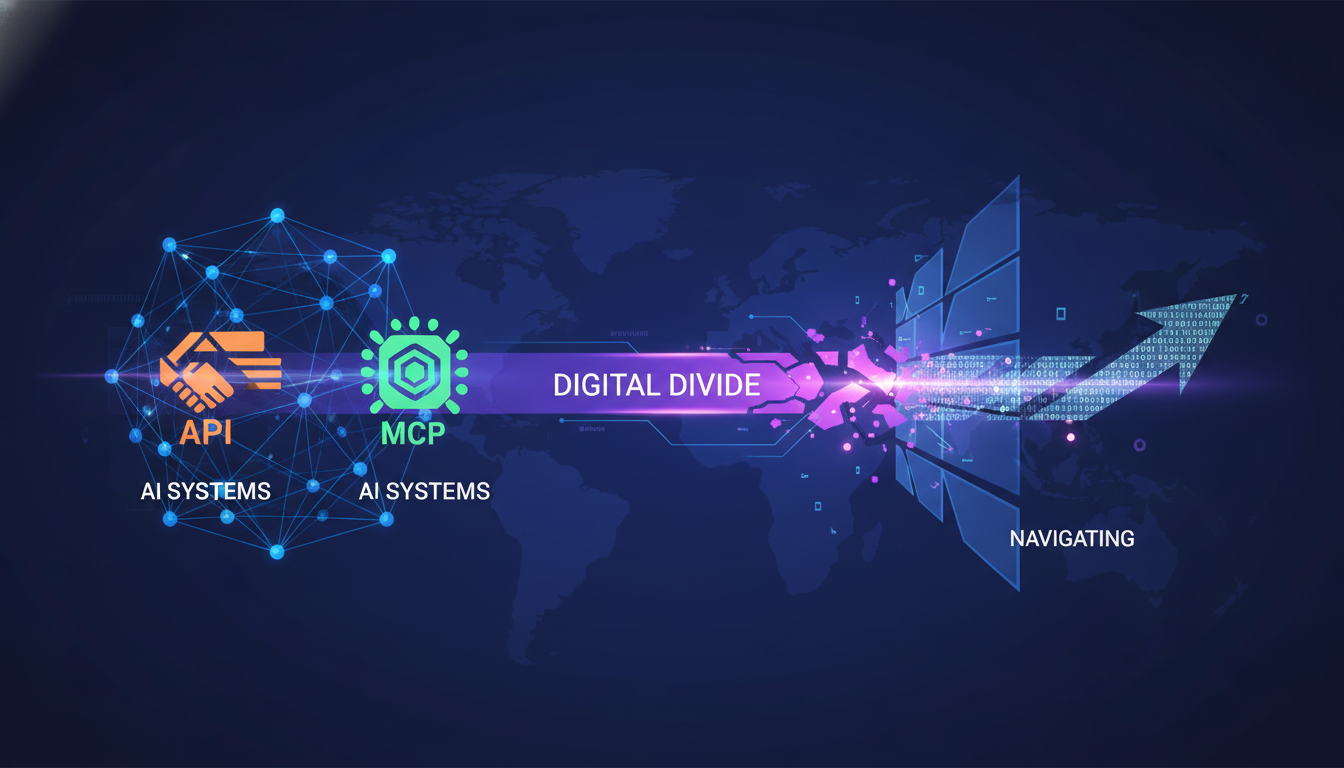
Navigating the Digital Divide: Understanding APIs and MCPs in AI Systems
The digital landscape is constantly evolving, and with it, the technologies that enable systems to communicate and function seamlessly. Two such technologies, APIs (Application Programming Interfaces) and MCPs (Model Context Protocols), play pivotal roles in AI systems. Understanding their differences and applications is crucial for developers and businesses looking to harness the power of AI effectively.
What Are APIs?
APIs are the backbone of modern software applications, facilitating communication between different software programs. An API allows one application to request data or services from another, using a predefined set of protocols. This interaction is typically straightforward: a request is sent in a specific format, and a response is received, also in a predetermined format. This makes APIs highly reliable and efficient, as long as both parties adhere to the agreed-upon protocols.
For instance, a weather application might use an API to fetch the latest weather data from a meteorological service. APIs are integral to many AI systems, enabling models to access necessary data quickly and efficiently.
Understanding MCPs
MCPs, or Model Context Protocols, are specifically designed for use with large language models (LLMs). Unlike APIs, MCPs provide a structured way for AI models to access a variety of data sources through a single interface. This is particularly useful when an AI model needs to perform complex tasks, such as querying business data repositories or executing specific actions.
MCPs serve three main functions:
- Tools: These are actions that the model can initiate, such as creating files or performing database searches.
- Resources: This refers to information the model can use as context for decision-making.
- Prompts: These are reusable templates that streamline common tasks, reducing the need for detailed input each time a task is performed.
The primary difference between MCPs and APIs is that MCPs are designed for direct consumption by AI models. They allow models to determine which tools or resources are necessary for a given task, optimizing data usage and processing efficiency.
APIs vs. MCPs: Not Just Wrappers
While both APIs and MCPs facilitate data exchange, they do so in fundamentally different ways. In some systems, MCPs act as intermediaries, calling APIs behind the scenes. However, APIs often provide more data than an AI model needs, leading to inefficiencies. For example, an API might return extensive customer data when only a single field is required. This excess data can increase processing costs and reduce the accuracy of the model's responses.
MCPs are tailored to deliver only the relevant data needed for a task, minimizing unnecessary data processing. This makes MCPs particularly valuable in scenarios where the nature of the data request is variable and context-dependent.
When to Use Each
APIs are best suited for applications where the required data and functions are well-defined and consistent. They are commonly used in web applications, mobile apps, and internal systems where specific, predictable data exchanges are necessary.
On the other hand, MCPs are ideal for scenarios where an AI model needs to access undefined or dynamic information. For example, an AI assistant that answers varied staff queries or reviews internal documents would benefit from the flexibility and efficiency of MCPs.
Many organizations use both APIs and MCPs to optimize data access and processing. A customer-facing app might use APIs for straightforward data retrieval, while an AI assistant in the same app utilizes MCPs to handle more complex, variable queries.
Security and Gateways
To manage the flow of data and ensure security, organizations often employ gateways. These software devices act as intermediaries, handling authentication, rate limits, logging, monitoring, and access control for both APIs and MCPs. As AI systems become more prevalent, understanding which tools are accessing data and what actions they can perform becomes critical.
However, while gateways provide valuable network-level security, they do not address vulnerabilities at the software layer. Just like firewalls, they can be bypassed, and may give a false sense of security if not carefully managed. Therefore, it is essential to maintain robust security practices beyond just implementing gateways.
Conclusion
In the realm of AI systems, both APIs and MCPs offer unique advantages and serve different purposes. APIs provide predictable and reliable data exchanges, while MCPs offer flexibility and efficiency for AI models handling complex, context-dependent tasks. By understanding and leveraging these technologies appropriately, businesses can enhance their AI capabilities and achieve more effective outcomes in the digital age.
Saksham Gupta
Founder & CEOSaksham Gupta is the Co-Founder and Technology lead at Edubild. With extensive experience in enterprise AI, LLM systems, and B2B integration, he writes about the practical side of building AI products that work in production. Connect with him on LinkedIn for more insights on AI engineering and enterprise technology.