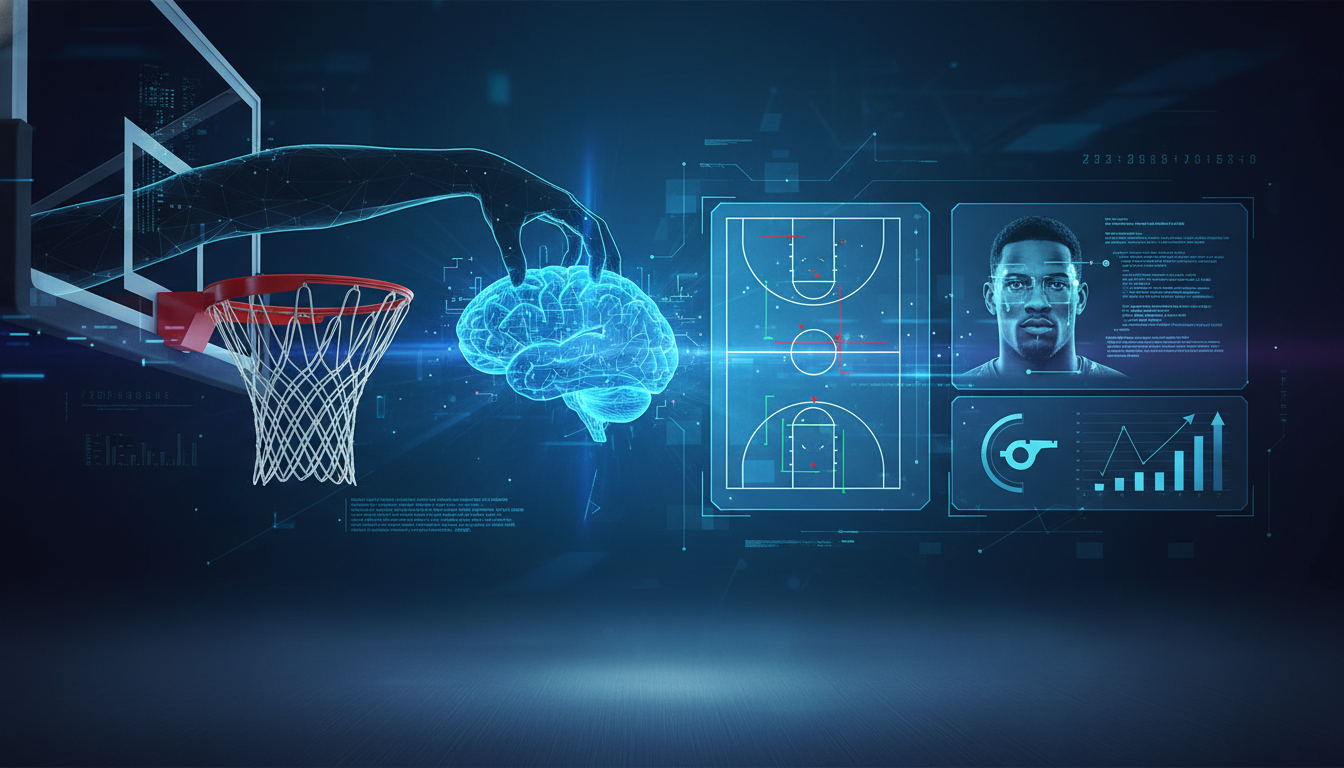
Slam Dunking Errors: How AI is Revolutionizing NBA Officiating
The National Basketball Association (NBA) is on the brink of a technological transformation that promises to enhance the accuracy of officiating, thanks to advancements in artificial intelligence (AI). This change comes amid a backdrop of increasing scrutiny over pivotal game decisions and the realization that technology can provide more precise and impartial adjudication in high-stakes environments.
A New Era of Officiating
NBA Commissioner Adam Silver recently announced the league's plan to implement an automated system for certain officiating decisions, starting with out-of-bounds calls. This innovative approach will leverage AI and strategically placed cameras around the court to accurately determine possession, mirroring the success of the Hawk-Eye system used in tennis for line calls.
The decision to move towards AI-assisted officiating was catalyzed by a controversial call during a recent Western Conference finals game, where a disputed out-of-bounds decision garnered significant attention. This incident underscored the need for an unbiased, technology-driven solution that minimizes human error and ensures fairness in the game.
The Role of Hawk-Eye Innovations
The NBA's collaboration with Sony's Hawk-Eye Innovations, initiated in 2023, is a cornerstone of this officiating revolution. Hawk-Eye's 3D optical tracking technology, which has been rigorously tested in NBA Summer League games and arenas, will be employed to track ball and player movements with sub-second precision. This technology is expected to expand its scope to include goaltending and other potential scenarios that benefit from automated decision-making.
The successful deployment of similar systems in other sports serves as a testament to its potential. Football has embraced semi-automated offside technology, while baseball is introducing an automated balls-and-strikes challenge system, showcasing the growing trend of AI integration in sports.
Streamlining Game Flow
One of the significant advantages of adopting AI in officiating is the reduction of game stoppages for reviews. Currently, the NBA's Coach's Challenge is the sole mechanism to review out-of-bounds violations during a game. This system allows each team one challenge, gaining a second only if the first is successful. By automating these calls, the NBA aims to eliminate the need for such interruptions, allowing the game to continue seamlessly.
This technological shift is not just about efficiency but also about preserving the sport's integrity. By ensuring that decisions are made swiftly and accurately, AI can help maintain the competitive nature of the game without the distractions of prolonged deliberations.
Human Judgment Still Essential
Despite the push towards automation, not all officiating responsibilities will be transferred to AI. Decisions involving judgment, particularly those related to fouls and contact, will remain under the purview of human referees. As Commissioner Silver highlighted, while contact occurs frequently in basketball, discerning its impact on play requires nuanced understanding and interpretation that AI is not yet equipped to handle.
This hybrid approach ensures that while technology aids in objective decision-making, the human element remains integral to managing the complexities of the game.
Looking Ahead
Although a specific timeline for the rollout of the AI system has not been provided, the NBA is committed to moving forward with this initiative swiftly. The anticipated benefits include not just improved accuracy and fairness in officiating but also an enhanced viewing experience for fans who can trust that the game is being officiated with the highest standards of precision.
As the NBA embraces this new era of AI-assisted officiating, it sets a precedent for other sports leagues to consider similar advancements. This move signals a broader trend of integrating technology to enhance the sporting experience, balancing the rich traditions of the game with modern innovations.
In conclusion, the introduction of AI in NBA officiating represents a significant leap forward in ensuring fairness and precision in basketball. By automating routine calls and preserving human judgment for more complex decisions, the NBA is setting a new standard for leveraging technology in sports. As this transformation unfolds, it promises to redefine how the game is played, watched, and enjoyed, solidifying basketball's status as a leader in sports innovation.
Saksham Gupta
Founder & CEOSaksham Gupta is the Co-Founder and Technology lead at Edubild. With extensive experience in enterprise AI, LLM systems, and B2B integration, he writes about the practical side of building AI products that work in production. Connect with him on LinkedIn for more insights on AI engineering and enterprise technology.