The Future of Automation: Navigating the Shift from RPA to Agentic AI
Introduction
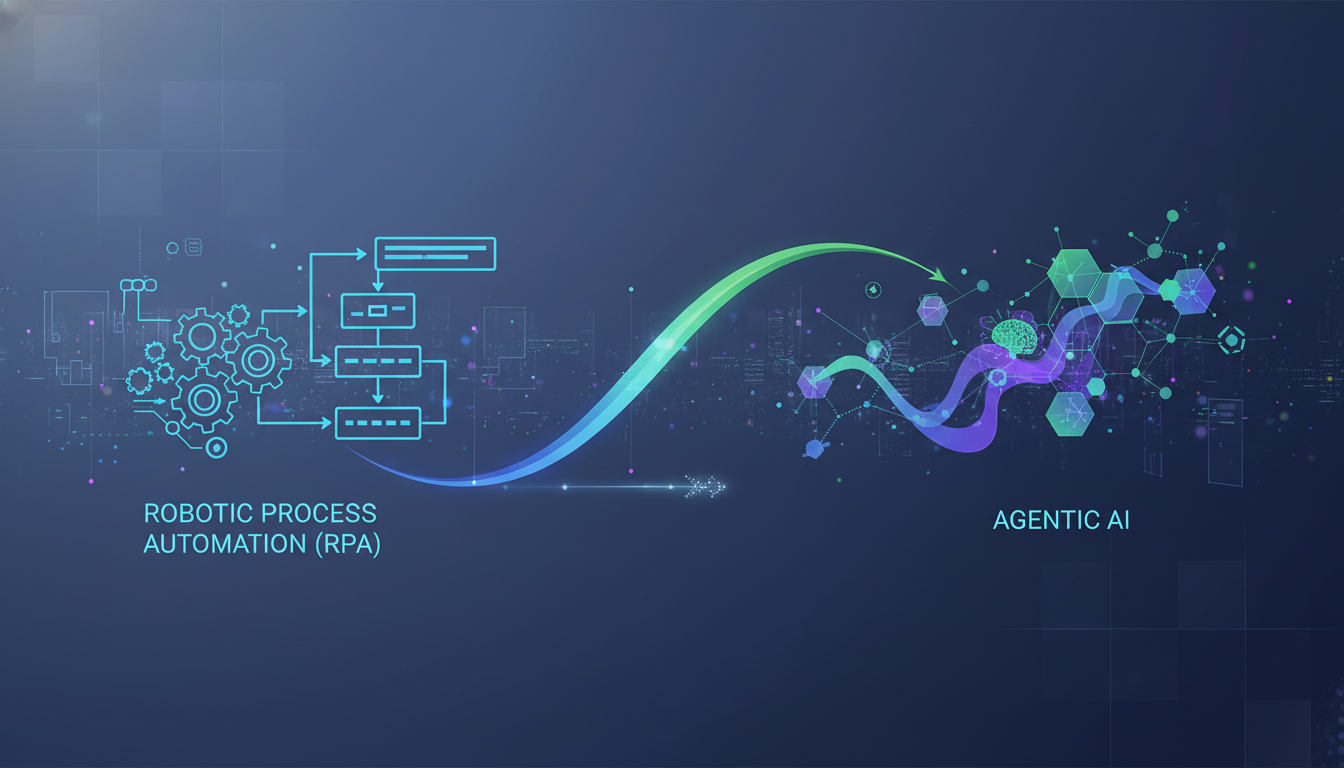
Automation in enterprises has evolved significantly, with traditional Robotic Process Automation (RPA) now being complemented and sometimes replaced by Agentic AI. While RPA has been instrumental in automating repetitive tasks based on predefined scripts, Agentic AI brings a revolutionary approach by automating outcomes and adapting to changes in real-time. This article explores the fundamental differences between RPA and Agentic AI, and how businesses can strategically navigate this technological shift.
Understanding RPA and Agentic AI
RPA is task-oriented, executing processes as per a fixed script. It excels in environments where tasks are structured and predictable. For instance, it is adept at handling high-volume data migrations or payroll processing, where the rules are consistent and unchanging. However, its reliance on user interfaces makes it fragile. Any change in the UI can lead to failures, necessitating constant script updates.
Agentic AI, on the other hand, is goal-oriented. It works by setting objectives and leveraging its ability to adapt, reason, and handle exceptions automatically. This makes it ideal for complex environments where data inputs are unstructured, such as variable-format invoices or customer communications that require contextual understanding.
Why Traditional RPA Hits a Ceiling
RPA's limitations become apparent as enterprises scale their automation efforts. Three primary failure modes restrict its effectiveness:
UI Fragility: RPA's dependency on specific interface elements means that any change in the UI can cause scripts to fail, leading to increased maintenance efforts.
Unstructured Data Handling: RPA struggles with unstructured data, which constitutes a significant portion of enterprise data. This leads to many processes being routed back to humans for manual handling.
Exception Handling: RPA is efficient on the 'happy path', but any deviation or exception often requires human intervention, creating operational bottlenecks.
The Role of Agentic AI
Agentic AI addresses the limitations of RPA by incorporating capabilities like contextual reasoning and adaptive learning. It can process unstructured data, manage exceptions by itself, and adapt to changes in real-time. This makes it particularly useful in scenarios requiring complex decision-making and cross-system orchestration.
For example, in compliance monitoring, where regulations frequently change, Agentic AI can read and interpret updates, adjusting its logic automatically without manual script modifications. This adaptability significantly reduces maintenance burdens and enhances process efficiency.
Building a Hybrid Automation Stack
The highest ROI often comes from a hybrid approach, where RPA and Agentic AI are used together. In this setup, Agentic AI functions as the decision-making layer, orchestrating workflows and handling exceptions, while RPA bots execute tasks where no API access is available. This architecture allows enterprises to leverage the strengths of both technologies, ensuring robust and flexible automation.
Deciding When to Migrate
Enterprises should not view the transition from RPA to Agentic AI as a complete replacement but rather as an evolution. The decision framework for adopting these technologies should consider:
- Process Stability: If RPA bots are stable and efficient, there is no immediate need to switch.
- Maintenance Burden: High maintenance costs and frequent breakdowns indicate a need for integrating Agentic AI.
- Exception Handling: If a large portion of workflows involve exceptions that RPA cannot handle effectively, introducing Agentic AI is beneficial.
- Data Complexity: New processes involving unstructured data are better suited for Agentic AI from the start.
Conclusion
The future of enterprise automation lies in the strategic integration of both RPA and Agentic AI. While RPA remains valuable for structured, repetitive tasks, Agentic AI offers capabilities that are essential for dealing with complex and dynamic business environments. By adopting a decoupled, orchestration-first architecture, enterprises can maximize automation coverage and efficiency, ensuring they are well-prepared for future advancements in technology. As automation technologies continue to evolve, businesses that embrace this hybrid model will find themselves at the forefront of operational excellence.
Saksham Gupta
Founder & CEOSaksham Gupta is the Co-Founder and Technology lead at Edubild. With extensive experience in enterprise AI, LLM systems, and B2B integration, he writes about the practical side of building AI products that work in production. Connect with him on LinkedIn for more insights on AI engineering and enterprise technology.