Launch Your RAG System in 30 Days: The Ultimate Playbook for Fast-Tracking Success
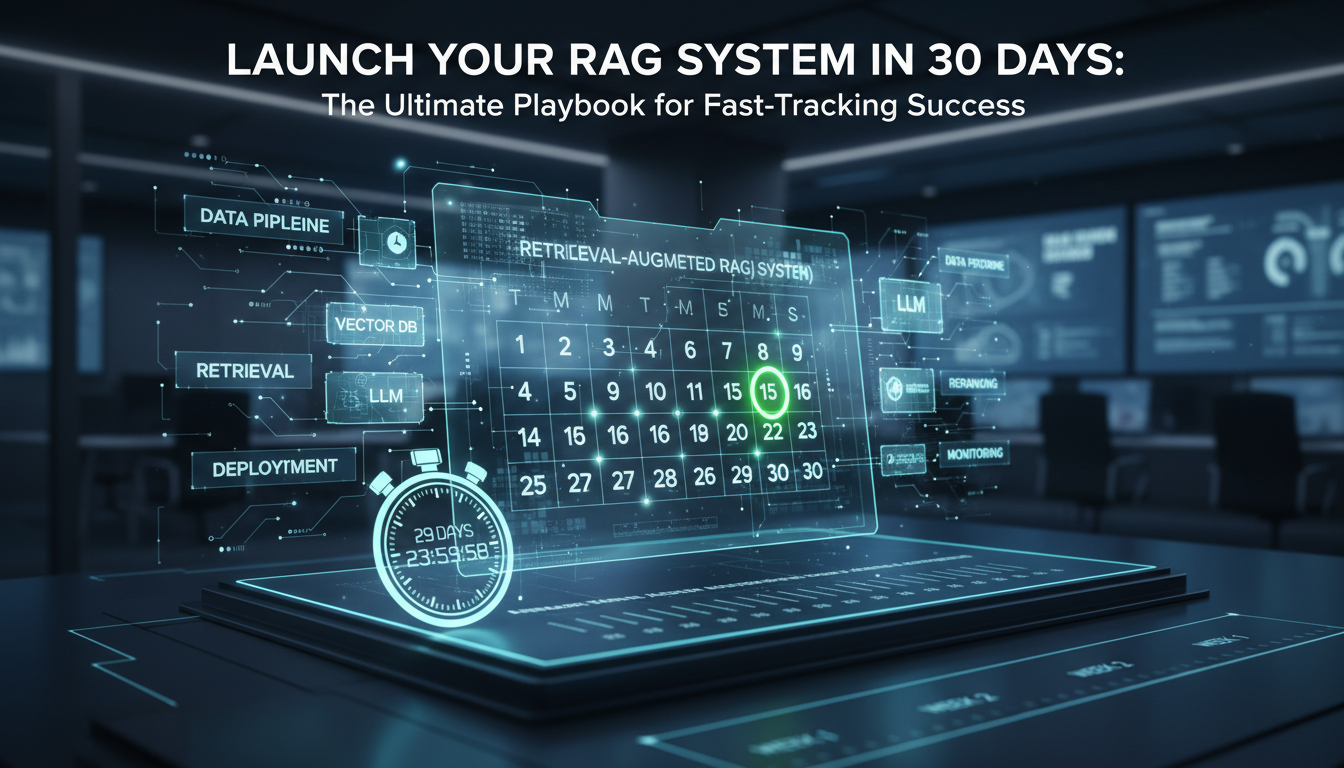
Launch Your RAG System in 30 Days: The Ultimate Playbook for Fast-Tracking Success
In today's fast-paced digital landscape, enterprises are under pressure to deploy robust Retrieval-Augmented Generation (RAG) systems quickly. The competitive edge is now defined by the ability to leverage AI for knowledge management. With the clock ticking, it's crucial to deploy a RAG system that works efficiently within 30 days. This playbook offers a step-by-step guide to achieving this goal without reinventing the wheel.
Week 1: Foundation Architecture and Data Readiness
Day 1-2: Scope Your Knowledge Base
Begin by clearly defining the scope of your knowledge base. Identify the types of documents you will be retrieving from, such as PDF policies, engineering specifications, or internal wikis. Understanding the query distribution is critical—determine whether users are asking about product features, compliance, or technical specifications. Additionally, assess the scale of your indexing needs to plan infrastructure costs and retrieval latency effectively. Validate your scope with stakeholders to prevent scope creep.
Day 3-5: Set Up Your Data Pipeline
Data quality is paramount. Use appropriate document loaders to ensure high-quality data input, as bad data can lead to incorrect responses. For most enterprises, starting with a SimpleDirectoryReader for bulk data is advisable. Make informed chunking decisions and attach relevant metadata to documents to enhance retrieval accuracy.
Day 6-7: Choose Your Vector Database
Selecting the right vector database will affect your entire RAG system. Options include open-source solutions like Qdrant, managed services like Pinecone, or a middle ground with Weaviate. Your choice will depend on your infrastructure control, operational overhead, and team expertise. Stick to your decision to avoid disrupting downstream processes.
Week 2: LLamaIndex Integration and Retrieval Optimization
Day 8-10: Stand Up Your Retrieval Pipeline
Integrate LLamaIndex with your chosen vector database. Implement a hybrid retrieval approach that combines keyword search with semantic search to enhance accuracy. This strategy ensures that both conceptual and specific queries are effectively addressed.
Day 11-13: Add Reranking for Precision
Enhance retrieval precision by implementing a reranking model. This step ensures that the most relevant documents are prioritized, reducing the chances of retrieving semantically similar but factually irrelevant documents.
Day 14: Build Your Evaluation Framework
Establish measurable success criteria to evaluate your RAG system's performance. Focus on retrieval accuracy, faithfulness, and latency. Using evaluation libraries will enable ongoing performance assessment and guide future improvements.
Week 3: LLM Integration and Query Processing
Day 15-17: Connect Your LLM and Test Response Quality
Integrate your retrieval pipeline with a Language Generation Model (LLM). Opt for a cost-effective yet high-quality option like GPT-4o mini for the initial deployment. Test responses to ensure they cite correct documents and match the desired tone and length.
Day 18-20: Add Context Compression and Multi-Query Handling
Enhance your system's ability to handle complex queries by incorporating context compression and multi-query handling. These capabilities improve the accuracy of responses to open-ended or follow-up questions.
Week 4: Deployment, Monitoring, and Iteration
Day 21-23: Deploy to Production
Deploy your system using a simple REST API. Ensure that you have authentication and rate limiting mechanisms in place to manage usage and prevent cost overruns. Log all queries and responses to create a feedback loop for continuous improvement.
Day 24-26: Implement Monitoring and Observability
Set up monitoring to detect issues such as retrieval quality drift, latency increases, hallucination rates, and cost spikes. Use observability platforms to integrate these signals and maintain system reliability.
Day 27-30: Iterate Based on Production Data
Use real-world data to refine your system. Address common issues such as low retrieval accuracy, latency spikes, and specific hallucinations. Iterate quickly to adapt your system to the evolving needs of your users.
The Cost and Infrastructure Reality
Deploying a RAG system involves various costs, including LLM API usage, vector database expenses, and potential inference infrastructure. However, these costs are significantly lower than manual alternatives, offering a scalable solution for handling enterprise queries.
What Happens After Day 30
Post-deployment, focus on specific pain points and expand the scope of your RAG system. Optimize costs by routing queries to the most appropriate models and build advanced capabilities to maintain a strategic competitive advantage.
By following this playbook, you can transform your RAG system from an experimental endeavor into a strategic asset within 30 days. Start now and position your enterprise at the forefront of AI-powered knowledge management.