Navigating the AI Wave: Insights into Agents, Models, and Governance
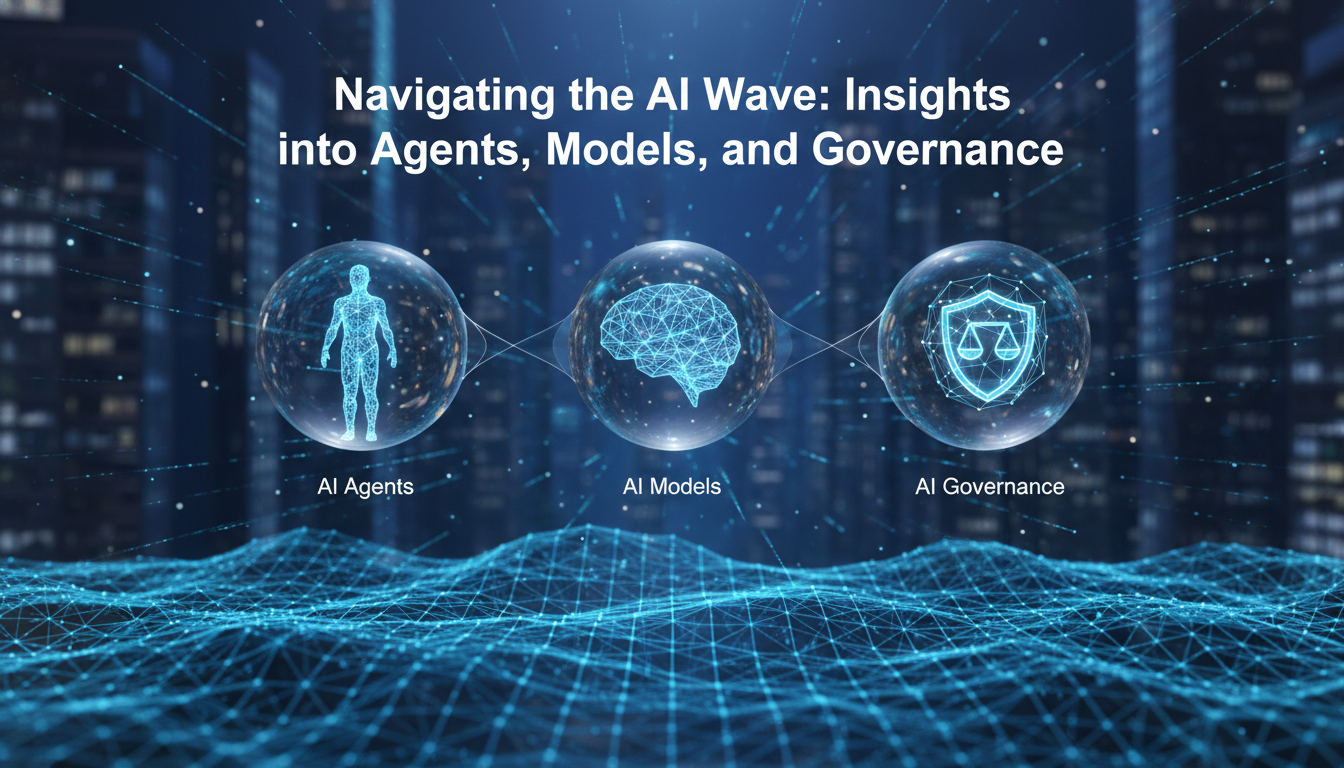
Navigating the AI Wave: Insights into Agents, Models, and Governance
As artificial intelligence (AI) continues to evolve, it becomes increasingly integral to various sectors, from healthcare to enterprise operations. The rapid advancement in AI brings forth challenges and opportunities that span across the development of AI agents, models, and governance frameworks. This article delves into these critical areas, offering insights into how they are shaping the AI landscape.
The Rise of AI Agents
AI agents have emerged as pivotal components in our digital ecosystems. These autonomous software systems leverage machine learning to perceive information, reason across data, and execute tasks with minimal human intervention. In sectors like healthcare, AI agents are revolutionizing clinical care and patient engagement, while in supply chain management, they enhance decision-making and efficiency.
One of the critical applications of AI agents is in the realm of Revenue Operations (RevOps). Here, they optimize processes by leveraging real-time data, providing automation and intelligence that transform the revenue lifecycle. The versatility of AI agents is further demonstrated by platforms like AgentGPT, which allows users to create and deploy these agents across various applications, exemplifying their growing importance in streamlining operations.
AI Models: The Backbone of Innovation
AI models are the engines that drive the capabilities of AI systems, enabling tasks such as natural language processing, image recognition, and more. Recent updates from leading AI companies like OpenAI and Anthropic highlight a sharpened focus on enterprise applications. These companies are pushing the boundaries with models like GPT-5.3-Codex and Claude Opus 4.6, which offer advanced functionalities for coding and enterprise AI integration.
The development and deployment of AI models are not without challenges. Ensuring that models are reliable, efficient, and secure requires robust frameworks like Proximal Policy Optimization, a reinforcement learning algorithm that helps agents make optimal decisions. As AI models become more sophisticated, they necessitate an infrastructure that supports seamless integration and scalability, crucial for enterprise adoption.
Generative AI: Transforming Creativity and Innovation
Generative AI, a subset of AI focused on creating new content, is transforming industries by enhancing creativity and innovation. It plays a crucial role in application development, where it assists in generating, optimizing, and translating code, thereby revolutionizing the software development lifecycle. This capability not only optimizes developer creativity but also enhances skill development, allowing for more consistent and innovative software solutions.
The integration of generative AI into existing systems poses its own set of challenges. Enterprises must navigate issues such as data privacy, ethical considerations, and the need for robust governance frameworks to ensure that AI technologies are implemented responsibly and effectively.
AI Governance: Ensuring Ethical and Responsible AI Use
As AI technologies permeate various aspects of life, the need for strong governance frameworks becomes paramount. AI governance encompasses the policies, regulations, and practices that guide the ethical and responsible use of AI systems. This includes ensuring transparency, accountability, and fairness in AI applications.
AI governance is particularly critical in areas like agent-driven social networks, where the potential for misuse and ethical concerns is high. As AI systems gain more autonomy, establishing clear guidelines and oversight mechanisms is essential to prevent unintended consequences and ensure that AI technologies benefit society as a whole.
The Future of AI: Challenges and Opportunities
The future of AI is both exciting and complex, characterized by rapid advancements and significant challenges. Key to navigating this landscape is the ability to balance innovation with responsibility. Organizations must invest in building AI capabilities that are not only cutting-edge but also ethically sound and aligned with societal values.
To achieve this, collaboration between industry, academia, and policymakers is crucial. By working together, stakeholders can develop robust frameworks that support the responsible development and deployment of AI technologies, ensuring that the benefits of AI are realized across all sectors.
In conclusion, as AI continues to evolve, its impact on industries and society will be profound. By understanding the intricacies of AI agents, models, and governance, organizations can better navigate the AI wave, harnessing its potential to drive innovation while ensuring ethical and responsible use.