Revolutionizing Farming: How Carbon Robotics' AI Model is Redefining Weed Management
Revolutionizing Farming: How Carbon Robotics' AI Model is Redefining Weed Management
Introduction
In the dynamic world of agriculture, innovation is key to overcoming persistent challenges. Carbon Robotics, a leader in agricultural technology, is at the forefront of this evolution with its groundbreaking Large Plant Model (LPM). This AI-driven solution is redefining how farmers manage weeds, a task that has long been both labor-intensive and time-consuming. By leveraging advanced machine learning techniques and a vast dataset, Carbon Robotics is poised to transform weed management, offering farmers unprecedented efficiency and adaptability.
The Challenge of Weed Management
Weed management has always been a critical component of successful farming. Traditionally, this process involves manual labor or the extensive use of herbicides, both of which have significant drawbacks. Manual labor is costly and labor-intensive, while herbicides pose environmental risks and contribute to the growing issue of chemical resistance. Farmers need a solution that reduces reliance on chemicals and manual efforts, while also adapting quickly to new challenges.
Carbon Robotics' Large Plant Model
The introduction of Carbon Robotics' Large Plant Model (LPM) marks a significant leap forward in agricultural technology. Trained on a staggering 150 million labeled plants from over 100 farms spanning 15 countries, the LPM offers a comprehensive understanding of plant structures and behaviors. This extensive training allows the AI to recognize and manage a diverse array of plant species without the need for retraining, a process that previously took up to 24 hours every time a new weed variety was encountered.
Real-Time Adaptability
What sets the LPM apart is its real-time adaptability. The model can instantly recognize and respond to unfamiliar plants by analyzing patterns across its extensive training data. This capability eliminates the downtime associated with retraining, allowing farmers to continue operations without interruption. As the LaserWeeder fleet, equipped with the LPM, operates across various fields, it continuously collects new data, enhancing the model's accuracy and efficiency through what Carbon Robotics terms a "compounding data flywheel effect."
Simplifying AI for Farmers
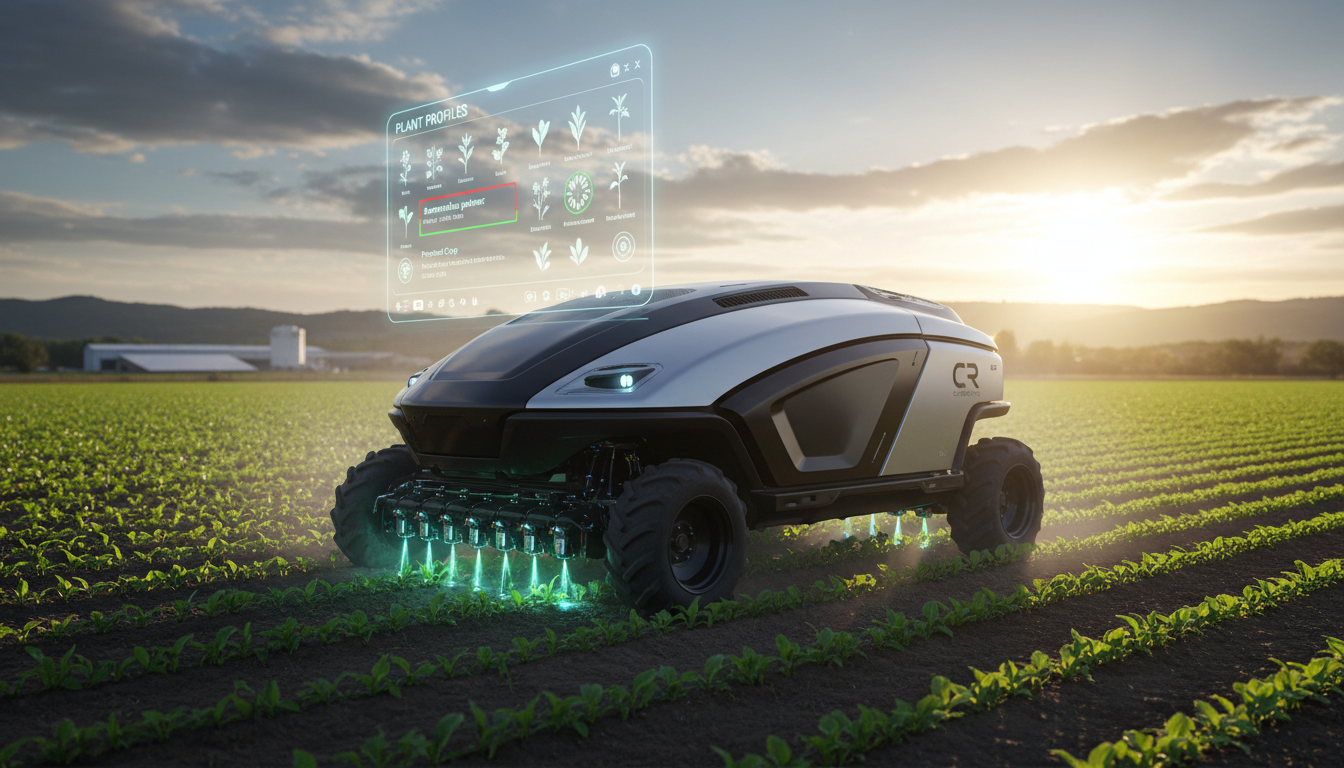
One of the most significant advantages of the LPM is its user-friendly interface. Carbon Robotics has developed a feature called Plant Profiles, which allows farmers to interact with the AI system without needing specialized knowledge in machine learning. Through a simple app, farmers can photograph plants they wish to target or protect, and the LaserWeeder adjusts its behavior accordingly. This intuitive design ensures that farmers can maximize the technology's benefits directly in the field, tailoring it to their specific needs.
Addressing Industry Challenges
The agricultural industry is currently grappling with a labor shortage and rising herbicide resistance. These challenges make the LPM's capabilities particularly timely. By reducing the dependency on manual labor and chemical herbicides, the technology provides a sustainable solution that not only maintains but potentially enhances crop yields. This innovation is crucial as farmers seek to balance productivity with environmental stewardship.
The Future of Agricultural AI
The launch of the LPM is more than just a technological advancement; it represents a paradigm shift in agricultural practices. As the foundational plant recognition layer becomes integral to farming infrastructure, Carbon Robotics is well-positioned to lead the industry. The company's robust dataset and continuous learning model ensure that its AI will remain at the cutting edge, providing a competitive edge that is difficult for others to replicate.
Conclusion
Carbon Robotics' Large Plant Model is revolutionizing weed management in agriculture through its sophisticated AI capabilities and user-friendly design. By addressing the challenges of labor shortages and chemical resistance, the LPM offers a viable path forward for sustainable farming. As the technology evolves and adapts, it promises to play a pivotal role in the future of agricultural practices, ensuring that farmers can achieve optimal efficiency and productivity with minimal environmental impact.