The AI Dilemma: Balancing Workforce Stability with Innovation
The AI Dilemma: Balancing Workforce Stability with Innovation
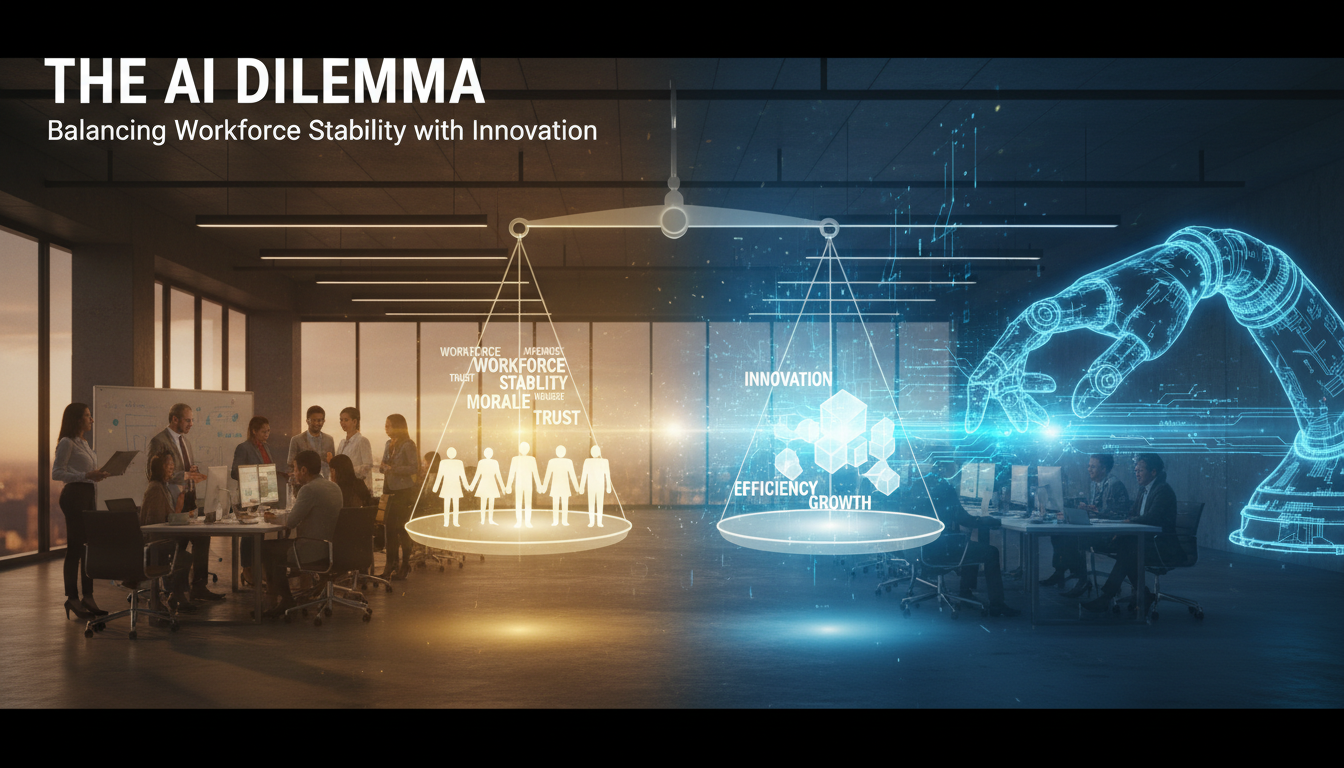
Artificial Intelligence (AI) has emerged as a transformative force in the business world, promising enhanced efficiency, cost savings, and innovation. However, as AI technologies continue to advance, they pose significant challenges related to workforce stability. Companies are grappling with the dual challenge of integrating AI to stay competitive while maintaining workforce stability and morale. This dilemma has sparked an ongoing debate: How can businesses leverage AI without sacrificing their human capital?
The Impact of AI on Employment
The introduction of AI into the workforce has led to varied outcomes across industries. While some organizations are using AI to optimize processes and redeploy employees into more strategic roles, others are resorting to workforce reductions. This dichotomy often depends on the business model and the role human interaction plays in a company's value proposition.
Goldman Sachs economists have estimated a monthly reduction of 5,000 to 10,000 jobs across U.S. industries due to AI advancements. Yet, this figure represents a fraction of the layoffs attributed to AI. The discrepancy highlights the complexity of AI's impact on employment—it's not solely about job elimination but also about job transformation.
Pro-Worker AI: A Strategic Approach
Certain companies have successfully integrated AI while upholding their commitment to workforce stability. Walmart and JPMorgan Chase serve as prime examples. These organizations have strategically utilized AI to complement human roles rather than replace them. For instance, at Walmart, AI manages backend operations, allowing employees to focus on customer interactions, which are crucial for maintaining customer loyalty and trust.
Similarly, JPMorgan Chase has used AI to automate back-office tasks, enabling client-facing teams to expand and enhance their services. The bank's redeployment strategy not only retains employees but also aligns with the organization’s focus on trust and regulatory compliance, areas where human judgment remains invaluable.
The Pitfalls of Workforce Reductions
Despite the positive examples, not all companies follow a pro-worker AI strategy. Organizations like Amazon and Accenture have invested heavily in upskilling initiatives yet have still resorted to significant layoffs. This trend reveals the limitations of retraining programs, especially when AI technologies rapidly outpace the skill development of the workforce.
Accenture’s workforce reduction underscores a critical point: while reskilling can bridge certain skills gaps, it is not a panacea. Companies must recognize the inherent limits of retraining and make strategic decisions about which roles can realistically transition alongside technological advancements.
Task Replacement vs. Job Replacement
A critical distinction in the AI conversation is that AI often replaces tasks rather than entire jobs. As a result, employees may find themselves in roles that have been significantly altered by technology, leading to uncertainty and job dissatisfaction. Economist Daron Acemoglu has noted that current AI technologies could boost productivity modestly, a reality that falls short of the sweeping promises made by some proponents of AI.
Physical tasks, particularly in retail and service environments, remain challenging for AI to replicate, providing a buffer for frontline workers. However, as AI continues to evolve, companies must keep a close watch on these roles and plan for future transitions.
Incentives and Business Models
The sustainability of pro-worker AI strategies often hinges on the company's incentives and business model. Businesses that derive direct, measurable value from human interaction are more likely to invest in retaining and redeploying their workforce. Conversely, in roles where AI can perform tasks more efficiently and cost-effectively, the incentive to retain human workers diminishes.
Organizations must carefully weigh the long-term implications of workforce reductions against the immediate benefits of AI-driven efficiencies. The challenge lies in finding a balance that supports innovation while valuing human capital—a balance that, if struck correctly, could lead to sustainable growth and a more resilient workforce.
Conclusion
The AI dilemma is not merely a question of technology adoption but one of strategic foresight and ethical responsibility. Companies that successfully navigate this landscape will be those that view AI as an augmentation of their workforce rather than a replacement. By focusing on roles that enhance human interaction and leveraging AI to streamline operations, businesses can achieve a harmonious balance between innovation and workforce stability. As the AI revolution continues to unfold, the organizations that prioritize their people alongside technological advancement will likely emerge as leaders in their industries.