Unleashing AI Potential: The Key Role of Harness Engineering in Agent Performance
Unleashing AI Potential: The Key Role of Harness Engineering in Agent Performance
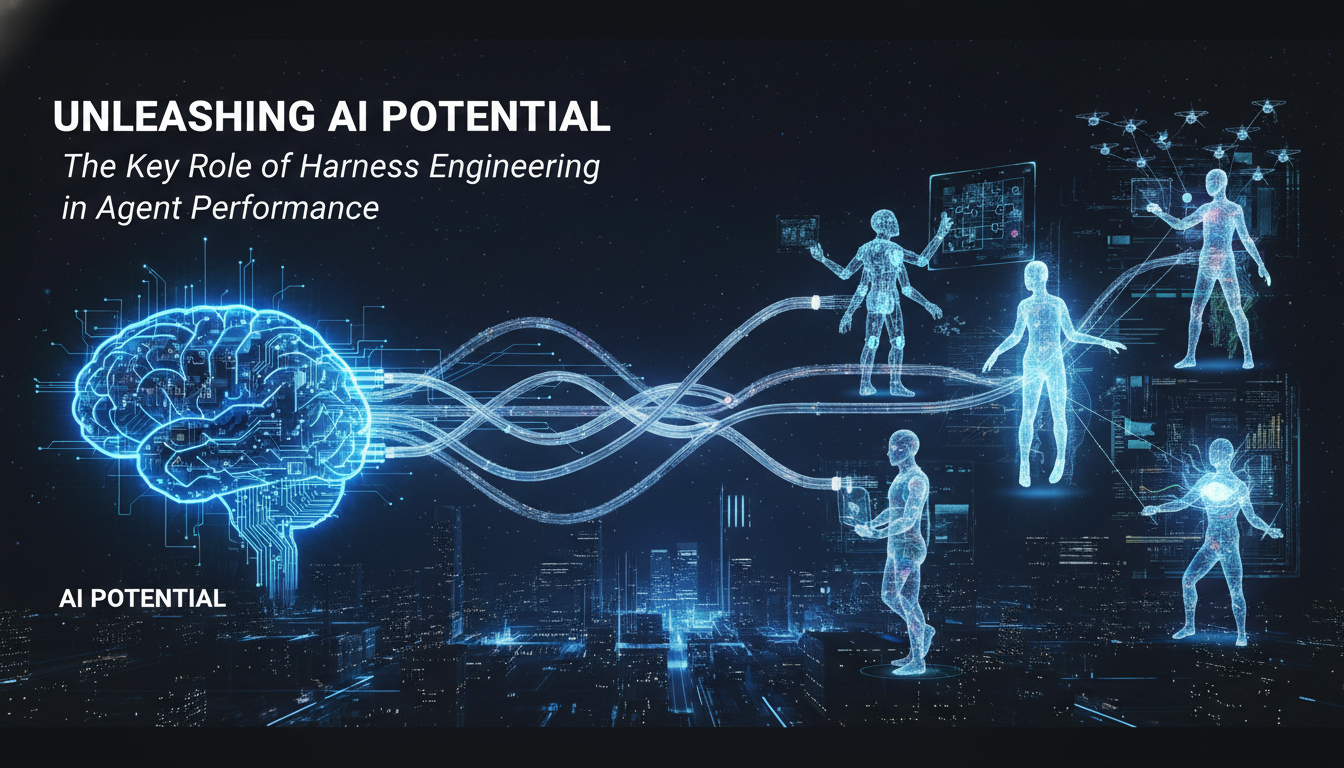
In the rapidly evolving world of artificial intelligence, the term "agent" often comes up to describe systems designed to perform tasks autonomously. However, the anatomy of an agent is often misunderstood. At its core, an agent is composed of two essential components: the model and the harness. While the model provides the intelligence, it is the harness that transforms this intelligence into actionable utility, making it the cornerstone in agent performance.
What is a Harness?
In the simplest terms, a harness encompasses all the components surrounding a model, excluding the model itself. It includes code, configuration, and execution logic that allows the model to function effectively as an agent. The harness adds crucial features such as state maintenance, tool execution, feedback loops, and constraints that are not inherently present in a raw model. These features enable the model to interact with the environment, execute code, and maintain a durable state across interactions.
The Necessity of Harnesses
Models, by themselves, have limitations. They are primarily designed to process data and output text, lacking the ability to maintain state, execute code autonomously, or access real-time information. Harnesses fill this gap by providing the necessary infrastructure to perform these tasks. For instance, they enable models to handle conversation-like interactions by maintaining the context of previous messages. This allows the model to generate responses that are coherent and contextually relevant.
Core Components of Harness Engineering
Filesystems for Durable Storage
One of the most fundamental components of a harness is the filesystem. It provides agents with a workspace to store data, code, and documentation. This allows for incremental work to be offloaded from the model's limited context window, enabling persistent state across sessions. File systems also facilitate collaboration among multiple agents and humans through shared files, making it an indispensable tool in harness engineering.
Bash and Code Execution
To empower agents with problem-solving capabilities, harnesses include tools like bash for code execution. This allows models to create solutions autonomously by writing and executing code, rather than relying solely on pre-configured tools. This flexibility is crucial for adapting to new problems without human intervention.
Sandboxes for Secure Execution
Harnesses also provide sandboxes where agents can safely execute code, inspect files, and complete tasks in an isolated environment. Sandboxes ensure secure execution by preventing potential risks associated with running agent-generated code locally. They also allow for scalability, as environments can be created and destroyed as needed, accommodating large agent workloads.
Enhancing Agent Memory and Learning
Harnesses play a pivotal role in memory and continual learning for agents. They support standards like AGENTS.md, which allow agents to store and recall knowledge from past sessions. This form of memory injection enables agents to build upon previous experiences, facilitating a form of continual learning.
Furthermore, harnesses incorporate tools for web search and querying up-to-date context, allowing agents to access information beyond their knowledge cutoff. This is essential for keeping the agents informed of the latest developments and data that were unavailable during their initial training.
Overcoming Context Rot
One significant challenge in harness engineering is managing context rot, where models degrade in performance as their context window fills up. Harnesses address this through strategies like compaction, which summarizes existing context to make room for new information, and tool call offloading, which manages large tool outputs by storing them externally.
The Future of Harness Engineering
As AI models become more sophisticated, some functions currently handled by harnesses may become inherent to the models themselves. However, harness engineering will remain critical in maximizing agent efficiency. Future advancements may include dynamic assembly of tools and context, orchestrating multiple agents on shared tasks, and empowering agents to self-diagnose and correct harness-level failures.
The synergy between model intelligence and harness engineering holds immense potential for advancing AI capabilities. By continuing to refine harness designs, we can unlock new levels of efficiency and functionality, paving the way for more sophisticated, autonomous agents. As we delve deeper into harness engineering, we move closer to realizing the full potential of AI.