When AI Meets Leadership: Inside Uber's "Dara AI" Experiment
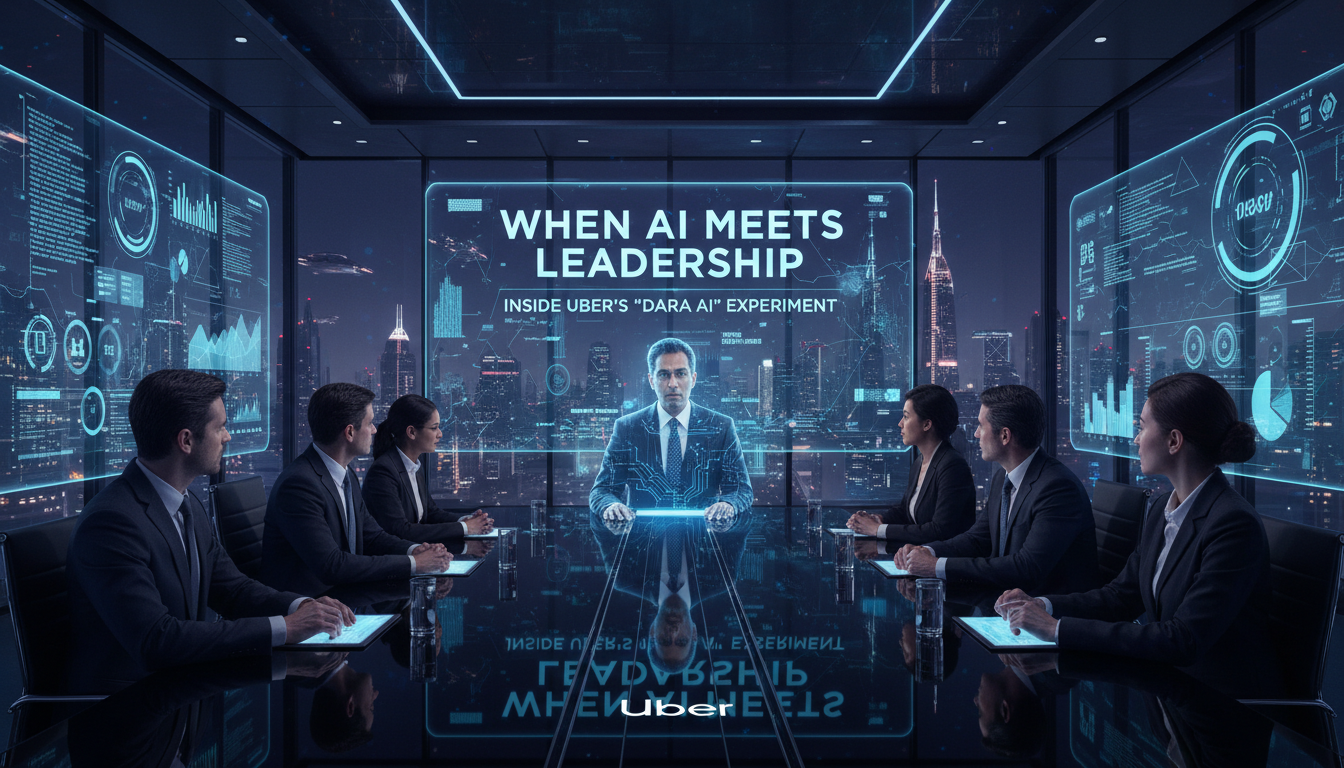
When AI Meets Leadership: Exploring the AI Proxy Experiment
In the ever-evolving landscape of technology, the intersection of artificial intelligence (AI) and leadership is creating new paradigms. A striking example comes from a leading ride-sharing service, where an AI proxy of the CEO was developed to help teams rehearse presentations before presenting to the actual executive. This experiment, while innovative, raises significant questions about AI adoption within corporate structures and the evolving role of executives.
The Implications of AI-Driven Preparation
The creation of an AI version of a company's CEO, designed to simulate executive review meetings, is a testament to how predictable certain corporate processes have become. For AI to effectively replicate a CEO's decision-making, it must be trained on consistent patterns. This suggests that the CEO's feedback during meetings often follows recognizable trends, providing stability but also highlighting the procedural nature of some executive functions.
This development prompts a critical question: If teams can rehearse with an AI model to refine their presentations, what unique value does the CEO bring to the table that cannot be anticipated or modeled? The CEO's role in providing judgment on novel situations or strategic redirection remains vital. However, the efficiency of the AI model suggests that much of the review process might be reducible to pattern recognition.
Innovation from the Ground Up
A noteworthy aspect of this AI proxy is that it was developed without explicit directives from top management. Engineers identified a bottleneck in the preparation process and autonomously created a tool to address it. Such bottom-up innovation is often lauded within tech circles, but it also presents challenges for executives who may feel a loss of control over how AI is deployed within their organizations.
The rapid integration of AI tools by software engineers—where a significant portion are rethinking architectural frameworks—reveals a governance gap. When leadership discovers such initiatives through external channels, it signifies a decentralization of control over AI deployment strategies.
The Strategic Dilemma: Agents or Engineers?
The efficiency gains provided by AI pose a strategic question for leadership. If AI can enhance productivity by a notable margin, should companies increase their engineering workforce to accelerate growth, or should they invest in AI tools and infrastructure to maximize existing capabilities?
This strategic tension is not unique to one organization. It is a broader consideration for any company navigating the integration of AI into its operations. The decision impacts not only resource allocation but also the future role of human expertise in a technology-driven environment.
The Future of Leadership in an AI-Powered World
The experiment with the AI proxy raises a provocative but essential question: Can AI eventually prepare executives for board reviews as effectively as it prepares teams for executive reviews? While current AI models may lack the ability to learn and adapt in real-time, this limitation is not permanent. The pace of AI development suggests that such capabilities may be within reach sooner than anticipated.
The core issue is not whether AI will replace executives but whether executives can adapt swiftly enough to remain indispensable in organizations where AI tools are rapidly being developed and implemented without direct oversight. This requires a rethinking of leadership roles and the incorporation of AI into strategic decision-making processes.
Embracing Change and Maintaining Relevance
As technical teams advance at a speed that governance structures struggle to match, organizations must embrace this change while ensuring robust oversight and strategic alignment. The creation of an AI proxy for leadership is not an attempt to replace human executives but a means to enhance efficiency in an existing system.
The challenge lies in how executives can harness these innovations to remain relevant and effective in an AI-driven enterprise landscape. Celebrating such initiatives while maintaining a strategic vision will be crucial for future leadership success.
In conclusion, the convergence of AI and leadership is not just an experiment but a glimpse into the future of corporate governance. As AI tools continue to evolve, they will challenge traditional roles and require leaders to adapt, ensuring that they remain at the forefront of strategic decision-making in a rapidly changing world.