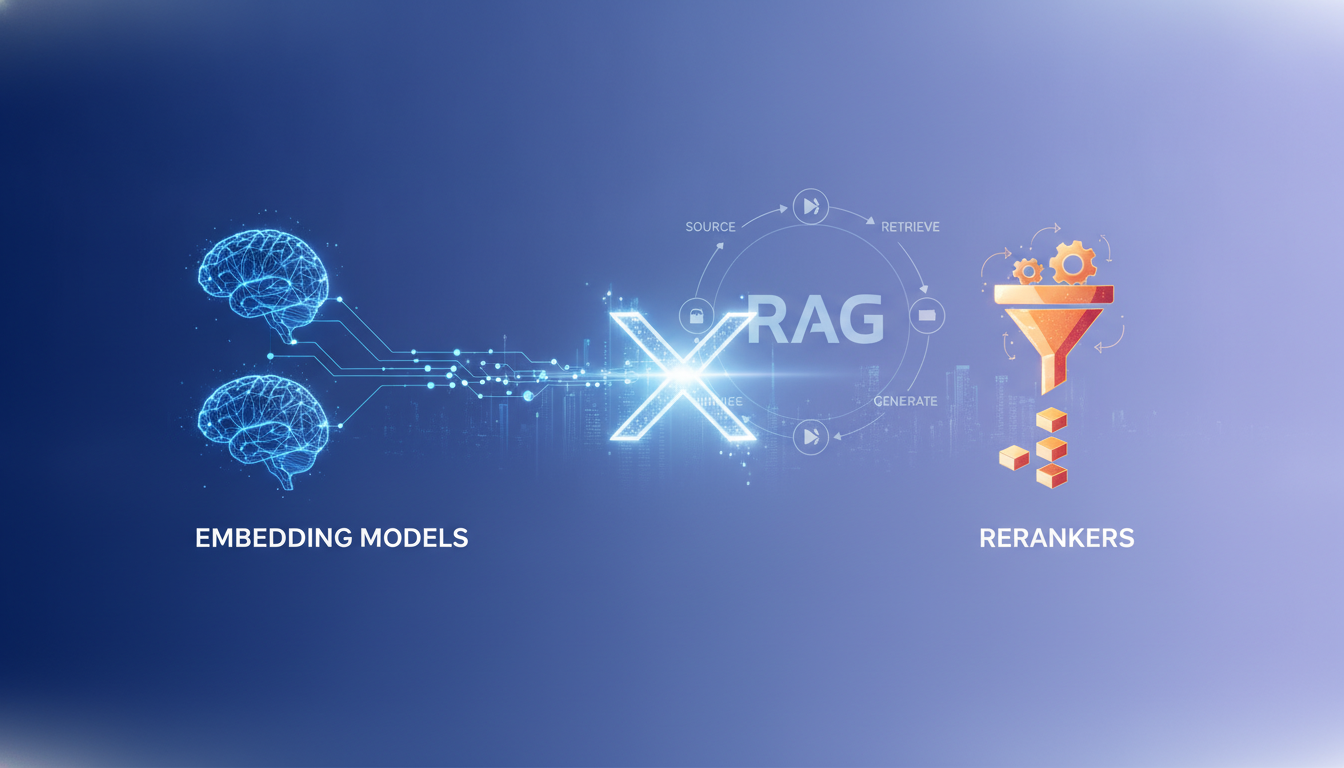
Embedding Models vs Rerankers: How to Choose the Right Combination for Your RAG System?
Hook
As enterprise leaders delve into AI-driven solutions, the challenge often lies in selecting the right components for optimal performance. With an array of embedding models and rerankers available, the decision-making process can be daunting. How do you ensure your Retrieval Augmented Generation (RAG) system meets your organization's specific needs?
Answer-first summary
Choosing the right combination of embedding models and rerankers for your RAG system involves evaluating your data characteristics, desired performance metrics, and operational constraints. By understanding the strengths of different models and aligning them with your organizational goals, you can enhance retrieval accuracy and efficiency, crucial for enterprise-scale operations.
What are Embedding Models and How Do They Work?
Embedding models are the backbone of modern RAG systems, translating textual data into numerical vectors that machines can understand. These models, such as those from OpenAI and CohereAI, differ in architecture and training data, impacting their suitability for specific tasks. For instance, OpenAI's embeddings are known for their general-purpose applications, while CohereAI may offer more domain-specific capabilities.
In practical terms, embedding models are selected based on their ability to capture the semantic meaning of data. Enterprises often face the decision of balancing between open-source options like sentence transformers, which offer flexibility, and proprietary models that may provide enhanced performance but at a higher cost. The choice depends on the volume and diversity of data and the specific use case, such as customer support or document processing.
Why Are Rerankers Important in a RAG System?
Rerankers play a crucial role in refining the initial retrieval results to improve the relevance of the output. After embedding models retrieve a broad set of potential matches, rerankers reorder these results to prioritize the most relevant ones based on additional context or criteria.
For enterprises, incorporating rerankers from providers like CohereAI can significantly enhance the precision of responses. This is particularly important in sectors like customer support, where accurate information retrieval can improve user satisfaction and operational efficiency. The decision to use a reranker should consider factors such as the complexity of queries and the criticality of precision in your business processes.
How to Evaluate the Performance of Embedding Models and Rerankers?
Performance evaluation of embedding models and rerankers relies on metrics like Hit Rate and Mean Reciprocal Rank (MRR). Hit Rate measures how often the correct answer appears in the top retrieved documents, while MRR assesses the rank of the first relevant document.
For example, in a test scenario involving JinaAI-v2-base-en with a bge-reranker-large, a Hit Rate of 0.938202 and an MRR of 0.868539 were observed. These metrics provide a quantitative basis for comparing different model combinations. Enterprises should set benchmarks based on these metrics, aligning them with business objectives such as response accuracy and processing speed.
How to Choose Between Different Embedding Models?
Choosing the right embedding model involves analyzing your data's nature and the model's ability to handle it. OpenAI embeddings are versatile, suitable for general applications, while models from CohereAI might offer advantages in specific domains.
Enterprises should consider factors such as the size of their data corpus, the diversity of topics, and the need for real-time processing. Open-source models like sentence transformers can be customized, making them a cost-effective choice for many organizations. However, proprietary models may offer superior performance for complex or niche applications.
What Role Does Data Play in Model Selection?
Data characteristics directly influence the selection of embedding models and rerankers. Organizations dealing with large, diverse datasets might prioritize models that excel in generalization, whereas niche industries could benefit from models trained on domain-specific data.
The nature of the data—structured vs. unstructured, volume, and update frequency—determines the model's effectiveness. For example, in document-heavy environments, leveraging OCR and document AI enhances the quality of input data for embeddings, thus improving retrieval outcomes.
What Are the Cost Implications of Different Model Choices?
Cost is a significant consideration for enterprises. Open-source models offer a budget-friendly entry point, but may require additional resources for customization and integration. Proprietary models, while potentially offering superior performance, come with licensing fees that must be justified by the value they add.
Enterprises should weigh the immediate costs against long-term benefits. For instance, investing in a premium reranker might reduce the need for extensive post-processing, thus saving operational costs. Decision-makers should also consider on-premise or private LLM deployments for data-sensitive applications, which can impact cost structures.
How to Implement the Chosen Models in Your RAG System?
Implementation involves integrating the chosen models into your existing systems, which may require technical adjustments and staff training. Working with a consultancy like EdubildAI can streamline this process, ensuring models are optimized for your specific use case.
The integration process includes setting up data pipelines, configuring model parameters, and establishing evaluation metrics. Enterprises should also plan for continuous monitoring and fine-tuning, leveraging services like LLM fine-tuning to adapt models to evolving data patterns and business needs.
Implementation Considerations
For enterprises, the right combination of embedding models and rerankers can transform operational efficiency and decision-making. The implementation should focus on aligning AI capabilities with strategic goals, ensuring models are not only effective but also scalable and maintainable.
Considerations include the technical infrastructure required to support model deployment, such as computing resources and data storage. Additionally, organizations must address data privacy and compliance, particularly when handling sensitive information. Choosing agentic AI customer support systems can help automate and enhance customer interactions while ensuring compliance with regulatory standards.
FAQ
What is the main advantage of using rerankers in a RAG system? Rerankers refine the initial set of retrieved documents, improving the relevance and accuracy of the results. This is crucial in applications where precision is paramount, such as in customer service or legal document retrieval.
How do I decide between open-source and proprietary embedding models? The decision should be based on your budget, data characteristics, and the specific requirements of your use case. Open-source models offer flexibility and cost-effectiveness, while proprietary models may provide better performance in specialized applications.
Can I use multiple embedding models in a single RAG system? Yes, combining multiple models can enhance system performance by leveraging the strengths of each. However, this requires careful integration and tuning to ensure compatibility and optimal results.
How important is it to continuously evaluate and tune my RAG system? Continuous evaluation and tuning are essential to maintain performance as data and business needs evolve. Regular updates and fine-tuning ensure the system remains effective and aligned with organizational goals.
Closing Call-to-Action
Ready to optimize your RAG system with the right combination of embedding models and rerankers? Contact us to explore how EdubildAI can enhance your enterprise AI strategy.
Saksham Gupta
Founder & CEOSaksham Gupta is the Co-Founder and Technology lead at Edubild. With extensive experience in enterprise AI, LLM systems, and B2B integration, he writes about the practical side of building AI products that work in production. Connect with him on LinkedIn for more insights on AI engineering and enterprise technology.