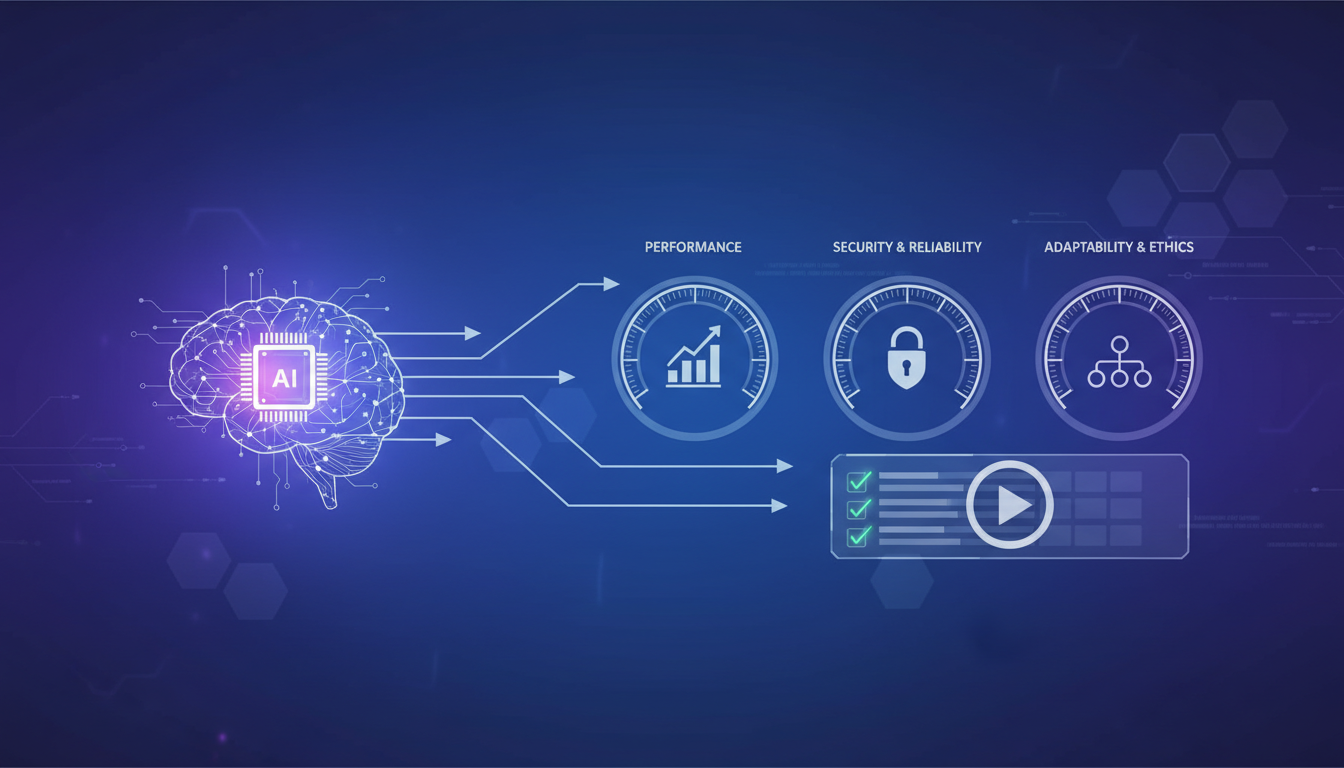
Mastering Agent Evaluation: Your Essential Readiness Checklist
Evaluating AI agents is a sophisticated process that diverges significantly from traditional software testing. Understanding the nuances of agent evaluation is crucial for ensuring that your AI performs reliably and effectively. This article provides a comprehensive checklist to guide you through the process of building, running, and shipping agent evaluations.
Understanding the Evaluation Process
Before diving into the checklist, it's essential to grasp the basics of agent evaluation. Unlike conventional software testing, agent evaluation involves observing the agent's behaviors and decision-making processes, which are dynamic and often unpredictable. The evaluation focuses on various levels, from single-step actions to multi-turn conversations, each revealing different aspects of agent performance.
Preparing for Evaluation
Manual Review of Agent Traces
Before setting up any evaluation infrastructure, manually review 20-50 real agent traces. This step is crucial for understanding failure patterns and gaining insights that automated systems might miss. Utilize tools like LangSmith to transition from traces to datasets and experiments effectively.
Define Success Criteria
Establish clear and unambiguous success criteria for each task. This ensures consistent evaluation across different assessors. For example, instead of vague instructions like "Summarize this document well," opt for specific tasks like "Extract the three main action items from this meeting transcript."
Separate Capability and Regression Evaluations
Differentiating between capability and regression evaluations is vital. Capability evaluations assess the agent's progress on challenging tasks, while regression evaluations ensure that existing functionalities remain intact. This separation helps in maintaining a balance between innovation and stability.
Building the Evaluation Infrastructure
Selecting Evaluation Levels
Understanding the three evaluation levels—single-step, full-turn, and multi-turn—is fundamental. Start with trace-level evaluations (full-turn) to gain comprehensive insights. As your infrastructure matures, incorporate run-level (single-step) and thread-level (multi-turn) evaluations to address specific needs.
Constructing Datasets
Ensure that each task in your dataset is unambiguous and includes a reference solution. Testing both positive cases (expected behavior) and negative cases (unexpected behavior) is critical. Tailor your datasets to match the evaluation level and the type of agent, whether coding, conversational, or research-focused.
Designing the Grader
Selecting Specialized Graders
Choose specialized graders for each evaluation dimension. Code-based graders are ideal for objective checks, while LLM-as-judge graders handle subjective assessments. Human graders are necessary for ambiguous cases, and pairwise graders are useful for version comparisons.
Implementing Guardrails and Evaluators
Differentiate between guardrails and evaluators. Guardrails operate inline and are designed to block dangerous outputs swiftly. Evaluators, on the other hand, perform asynchronous quality assessments and are crucial for catching regressions.
Running and Iterating Evaluations
Offline, Online, and Ad-hoc Evaluations
Utilize all three evaluation types—offline for controlled pre-deployment testing, online for ongoing production assessments, and ad-hoc for exploratory analysis. Each type plays a distinct role in maintaining and improving agent performance.
Multiple Trials and Fairness Verification
Run multiple trials per task to account for non-determinism. This approach helps in obtaining reliable results. Additionally, manually review traces of failed evaluations to ensure grader fairness and accuracy.
Continuous Improvement
Recognize when pass rates plateau and evolve your test suite accordingly. Keep only the evaluations that directly measure production behaviors of interest. This focus ensures that your evaluation efforts remain aligned with real-world needs.
Production Readiness
Integrating with CI/CD Pipelines
Promote capability evaluations with high pass rates into your regression suite and integrate them into your CI/CD pipeline. This integration ensures that quality gates are in place before any updates reach production.
Capturing and Utilizing User Feedback
Once in production, user feedback becomes invaluable for identifying unforeseen failure modes. Structuring this feedback allows you to refine datasets and calibrate graders effectively, ensuring continuous improvement.
Version Control and Feedback Loops
Version your prompts and tool definitions alongside your code to correlate eval results with specific changes. Ensure that production successes and failures feed back into datasets, error analysis, and evaluation improvements, creating a robust feedback loop for ongoing enhancement.
By following this checklist, teams can build a solid foundation for agent evaluation, enhancing their AI's reliability and effectiveness. Remember, the key to mastering agent evaluation lies in starting early and iterating continuously.
Saksham Gupta
Founder & CEOSaksham Gupta is the Co-Founder and Technology lead at Edubild. With extensive experience in enterprise AI, LLM systems, and B2B integration, he writes about the practical side of building AI products that work in production. Connect with him on LinkedIn for more insights on AI engineering and enterprise technology.