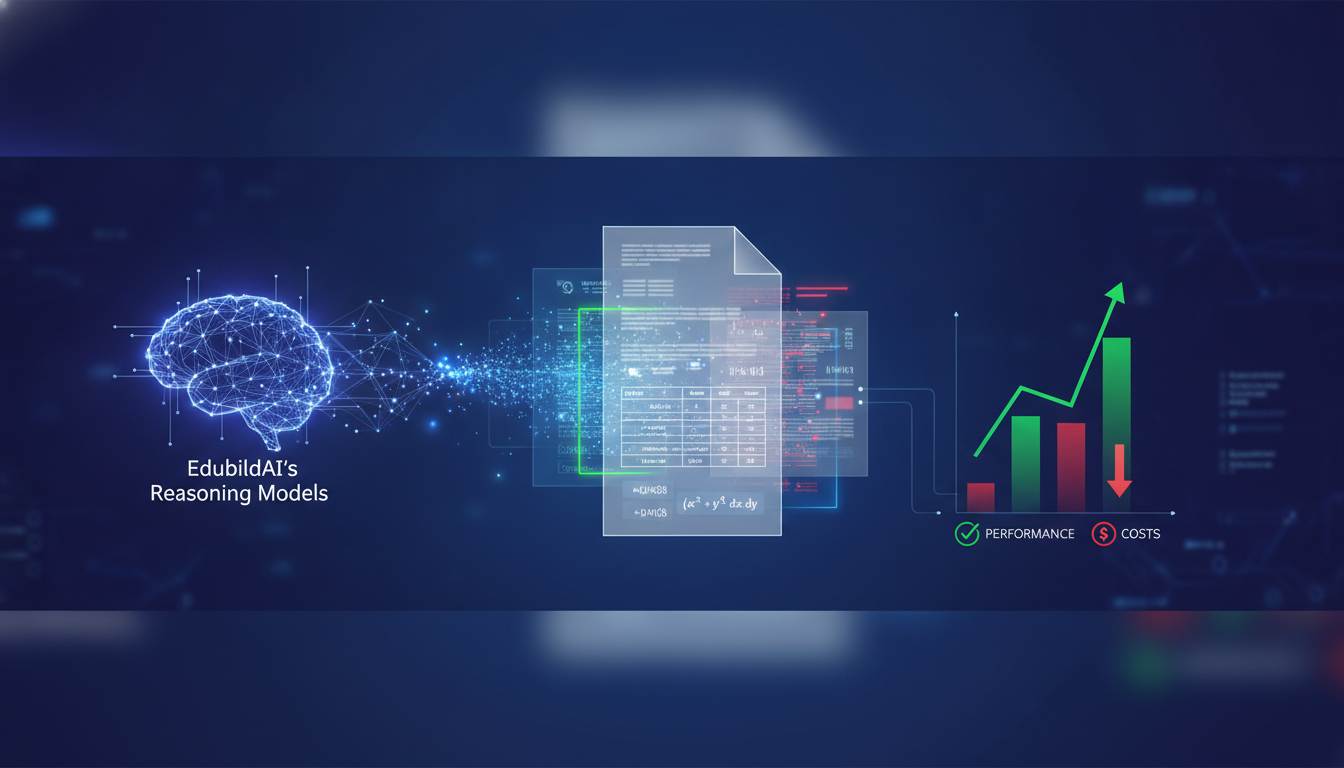
Improving OCR Accuracy in Complex Documents: How EdubildAI's Reasoning Models Can Reduce Costs and Enhance Performance
Hook: Understanding the Challenges of OCR in Complex Documents
In today's data-driven world, enterprises frequently encounter complex documents filled with intricate tables, mathematical formulas, and multi-column layouts. Misinterpretation in OCR can lead to significant errors, affecting financial reports, scientific research, or legal documents. How can enterprises ensure the accuracy of OCR while optimizing costs?
Answer-first summary: Why EdubildAI's Reasoning Models are the Solution
EdubildAI leverages advanced reasoning models to enhance OCR accuracy in complex documents. By optimizing processing power and reducing unnecessary reasoning, our solutions provide high-quality outcomes at lower costs. This approach not only improves performance but also reduces latency and cost, ensuring efficient document processing.
How Do Reasoning Models Affect OCR Accuracy?
Reasoning models in OCR systems can significantly impact performance and cost. These models are designed to allocate processing resources to challenging sections of a document, such as complex tables or mixed text orientations. However, as our analysis shows, higher reasoning does not always correlate with improved OCR accuracy. For instance, in one study involving GPT-5.2, we observed that increased reasoning levels did not enhance quality, which remained constant around 0.79. Instead, they increased latency and cost by 5-8 times. This suggests that while reasoning is valuable, excessive reasoning can lead to inefficiencies and increased expenses without corresponding benefits.
What Makes EdubildAI's Approach Different?
EdubildAI's methods diverge from traditional single-pass OCR systems by adopting a pipeline-based approach. This involves using specialized components for distinct tasks: dedicated OCR for pixel-level extraction and LLMs for organizing the extracted text. Our proprietary LlamaParse Agentic system exemplifies this approach by outperforming high-reasoning models in terms of both speed and quality. Unlike systems that overthink, our method prevents issues like hallucinations and structural misinterpretations, ensuring that reasoning is applied only where it adds value.
Can Reasoning Models Reduce OCR Costs?
Yes, reasoning models can reduce OCR costs when applied judiciously. The key is to balance reasoning with efficient processing. For example, our LlamaParse Agentic system processes documents faster and more accurately by focusing on essential reasoning tasks. This approach leads to a significant reduction in processing time and cost, as evidenced by our deployment with India's Ministry of Statistics, where we achieved a 20% reduction in operational costs while maintaining high accuracy.
How Does EdubildAI Ensure High Performance in OCR Systems?
Performance in OCR systems is not just about accuracy but also speed and cost-effectiveness. At EdubildAI, we ensure high performance by integrating agentic reasoning loops that validate structured outputs against raw data. This method prevents errors typically associated with overthinking, such as unnecessary table splitting or incorrect content inference. By doing so, we maintain the structural integrity of documents, as seen in our Cleo first-response automation, where agentic reasoning enhanced customer support efficiency.
What this means for your organization
For enterprises, adopting EdubildAI’s OCR solutions means more than just improved document processing. It translates to tangible cost savings, reduced latency, and enhanced document integrity. By avoiding the pitfalls of excessive reasoning, organizations can streamline their operations and allocate resources more effectively. This is particularly crucial in the Indian market, where cost efficiency and reliability are paramount. Implementing our solutions can lead to a more agile and responsive enterprise, ready to tackle complex document challenges without incurring unnecessary costs.
FAQ
Q1: How does reasoning improve OCR accuracy in non-text elements? Reasoning models excel in interpreting non-text elements, such as logos and icons, by understanding their context rather than merely transcribing them. This capability is crucial for documents where visual elements are integral to the content.
Q2: Can EdubildAI's systems handle low-quality scans? Yes, our systems are designed to handle low-quality scans effectively. By using native-resolution OCR, we ensure that no details are lost during the image encoding phase, maintaining high accuracy even in challenging conditions.
Q3: What is the cost advantage of using EdubildAI's OCR solutions? Our solutions offer a significant cost advantage by reducing processing time and minimizing unnecessary reasoning. This results in lower operational costs while maintaining or enhancing the accuracy of document processing.
Closing Call-to-Action
Ready to enhance your document processing capabilities? Contact us today to learn how EdubildAI's innovative OCR solutions can benefit your organization.
Saksham Gupta
Founder & CEOSaksham Gupta is the Co-Founder and Technology lead at Edubild. With extensive experience in enterprise AI, LLM systems, and B2B integration, he writes about the practical side of building AI products that work in production. Connect with him on LinkedIn for more insights on AI engineering and enterprise technology.