RAG vs Fine-Tuning: Which Does Your Enterprise Need?
In the ever-evolving landscape of enterprise AI, decision-makers are often faced with the dilemma of choosing between Retrieval-Augmented Generation (RAG) systems and fine-tuning language models. As the demands for efficient data processing and intelligent systems grow, understanding the optimal approach for your enterprise can be daunting.
Enterprises must decide whether to implement RAG systems, which enhance information retrieval with AI capabilities, or to fine-tune pre-existing language models for specific tasks. Each approach has its own strengths and is suited to different scenarios depending on the enterprise's needs, data availability, and infrastructure.
What is the primary difference between RAG and fine-tuning?
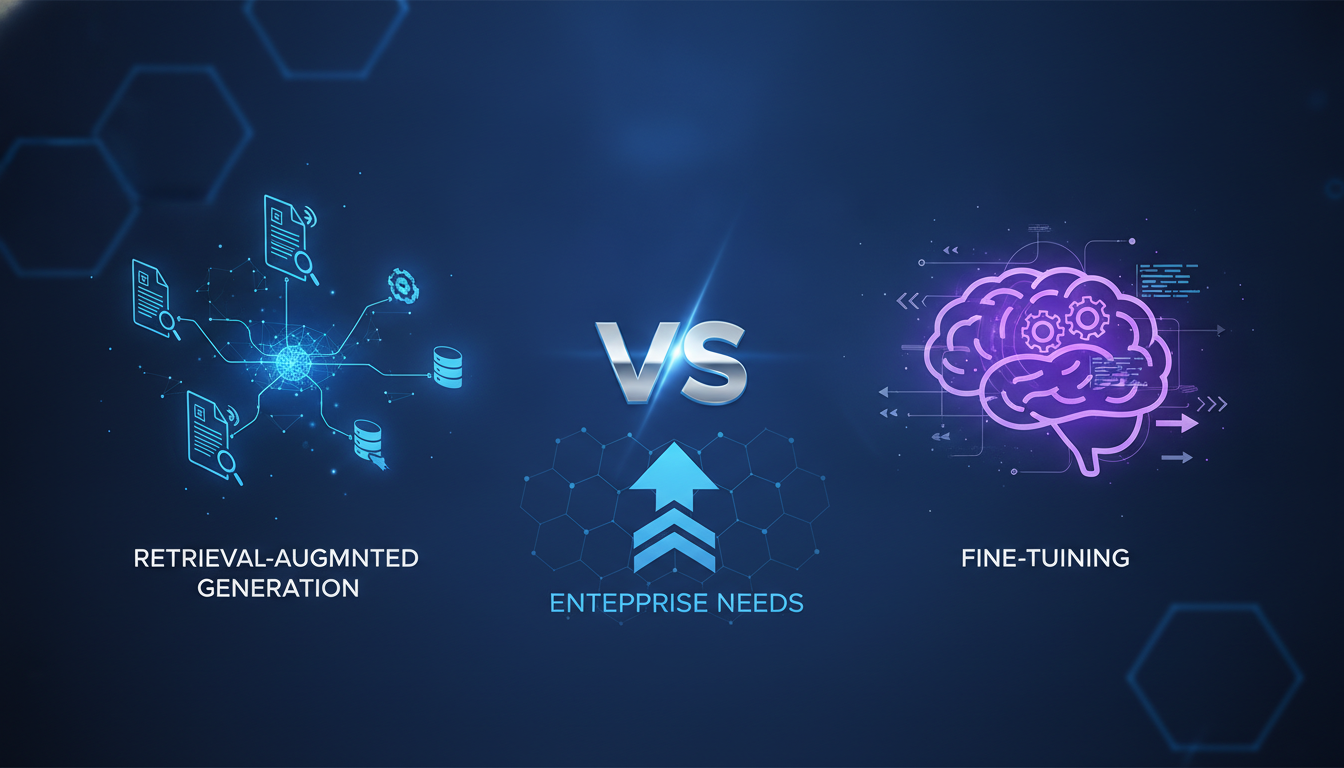
RAG systems integrate AI-driven retrieval processes with generative capabilities, offering enhanced data access and query responses. Fine-tuning, on the other hand, involves adapting a pre-trained model to a specific task by updating its parameters with task-specific data. RAG is ideal for scenarios where real-time information retrieval is critical, while fine-tuning is suited for tasks requiring high accuracy on specific datasets.
When should enterprises consider RAG systems?
RAG systems are particularly beneficial when:
- Data is dispersed across multiple sources: For enterprises like Cleo, which use RAG over Zendesk support tickets, integrating various data sources into a coherent retrieval system can streamline customer support.
- Real-time information is crucial: In dynamic environments where up-to-date information is necessary, RAG systems can efficiently handle queries by merging retrieval and generation capabilities.
- Scalability is a priority: RAG systems can be expanded with minimal impact on existing infrastructure, making them suitable for growing enterprises.
For more insights on RAG systems, explore how we have implemented solutions for enterprises.
What are the advantages of fine-tuning?
Fine-tuning is advantageous in situations where:
- High task-specific accuracy is required: By adapting a model to a specific dataset, enterprises can achieve greater precision in tasks such as document classification or sentiment analysis.
- Data consistency is available: For tasks with well-defined and consistent data, fine-tuning can enhance performance significantly.
- Customizability is needed: Fine-tuning allows enterprises to tailor models to their specific needs, which is beneficial for unique business processes.
Learn more about our LLM fine-tuning services and how they can be customized for your enterprise.
How does the Indian enterprise landscape influence the choice?
In India, with its diverse business environment and rapidly growing tech sector, the choice between RAG and fine-tuning often depends on infrastructure and data management capabilities:
- Government and large enterprises: As seen with the Ministry of Statistics (MoSPI), RAG systems are favored for handling extensive and varied datasets across departments.
- Medium-sized enterprises: These organizations may benefit more from fine-tuning, allowing them to leverage AI with existing data without significant infrastructure overhauls.
Implementation considerations for your organization
When deciding between RAG and fine-tuning, consider the following:
- Data infrastructure: Assess whether your current data infrastructure can support real-time retrieval or if it aligns better with a fine-tuning approach.
- Resource availability: Fine-tuning requires access to high-quality task-specific data and computational resources.
- Business objectives: Align your choice with strategic goals, such as improving customer support with Agentic AI customer support or enhancing document processing with OCR solutions.
FAQ
1. Can RAG systems be integrated with existing enterprise software?
Yes, RAG systems can be integrated with existing enterprise software, enhancing data retrieval processes without disrupting current operations. Our on-premise LLM deployment can help with seamless integration.
2. Is fine-tuning cost-effective for small enterprises?
Fine-tuning can be cost-effective if the enterprise has access to high-quality data and specific use cases that require customized AI solutions. It avoids the costs associated with developing a model from scratch.
3. How does RAG handle multilingual data?
RAG systems can be designed to handle multilingual data by integrating language-specific retrieval and generative capabilities, making them versatile for diverse linguistic environments.
4. What are the security implications of using RAG or fine-tuning?
Both approaches require secure data handling practices. RAG systems need robust access controls for data sources, while fine-tuning necessitates secure storage and processing of training data.
For tailored advice on choosing the right AI strategy for your enterprise, contact us today.
Saksham Gupta
Founder & CEOSaksham Gupta is the Co-Founder and Technology lead at Edubild. With extensive experience in enterprise AI, LLM systems, and B2B integration, he writes about the practical side of building AI products that work in production. Connect with him on LinkedIn for more insights on AI engineering and enterprise technology.