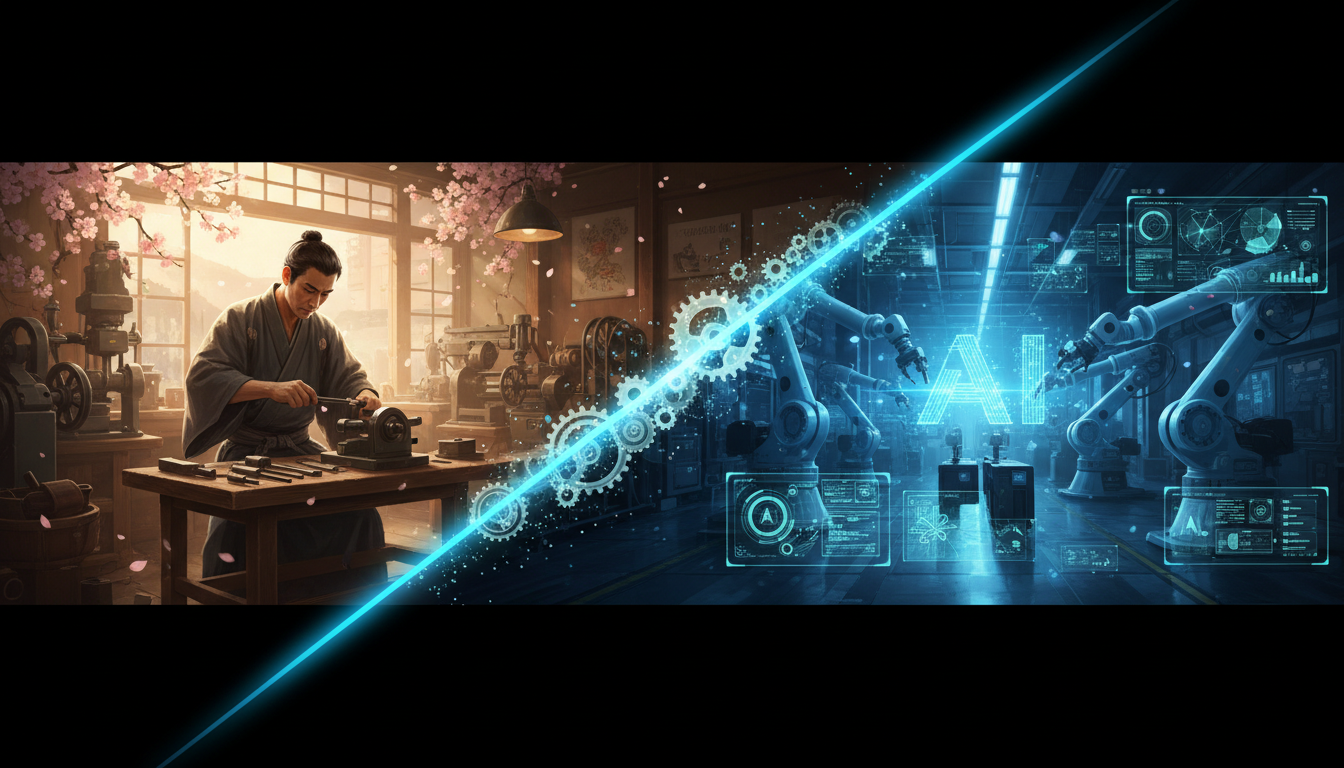
Turning Tradition into Technology: How AI is Revolutionizing Japan's Precision Manufacturing
Introduction
In the heart of Kanazawa, Japan, a quiet revolution is underway. The precision manufacturing industry, long a bastion of traditional craftsmanship, is experiencing a seismic shift thanks to the integration of artificial intelligence (AI). ARUM Inc., a pioneering company in the sector, is at the forefront of this transformation. By developing AI-driven solutions, they are addressing the industry's labor shortages and enhancing productivity. This article delves into how ARUM is leveraging AI to turn traditional manufacturing practices into scalable, automated processes.
The Labor Challenge in Precision Manufacturing
Japan's precision manufacturing sector, valued at approximately $15 billion, has maintained a global leadership position thanks to its dominance in sectors like semiconductors, robotics, and optics. However, the industry faces a critical challenge: a dwindling workforce. The Ministry of Health, Labor and Welfare has labeled the shortage of skilled machinists as "long-lasting and persistent," with job openings surpassing available candidates.
Introducing ARUMCODE and TTMC
ARUM Inc., led by CEO Takayuki Hirayama, has been proactive in tackling this issue by embracing automation and AI. Their flagship products, ARUMCODE and TTMC (Type F), are designed to automate the entire production process, making it accessible to less-skilled workers. ARUMCODE, an AI software, transforms computer-aided design (CAD) drawings into manufacturable instructions, significantly reducing the time required for programming CNC machines.
The TTMC Type F, a fully automated machining center, physically executes these instructions with minimal human intervention. This combination allows for efficient production cycles, critical for manufacturers of "high-mix, low-volume" precision parts where customization is key.
Bridging the Gap Between Craftsmanship and Code
Takaaki Sakashita, the general manager of ARUM’s software development team, plays a pivotal role in bridging the gap between traditional craftsmanship and modern technology. With over two decades of experience, Sakashita translates the intuition and expertise of seasoned machinists into algorithms and databases. This knowledge is then used to train ARUMCODE, enabling it to understand and automate complex machining processes.
The development of ARUMCODE involved compiling a vast database of materials, shapes, and cutting patterns. By using a graph neural network, the team was able to teach the AI how these elements interact, streamlining the transition from design to production.
The Impact of AI on Efficiency and Profitability
The introduction of AI into ARUM’s processes has resulted in substantial efficiency gains. Tasks that once took hours now take minutes, allowing for faster prototyping and production. For instance, creating a machine program for an aircraft wing rib, a task that previously took over an hour, now only takes four minutes with ARUMCODE.
These advancements have had a profound impact on ARUM’s business model. The company has shifted from being a subcontractor with limited profits to a fabless company focused on design and development. This pivot has led to an eight- to ten-fold increase in profits, demonstrating the transformative power of AI in manufacturing.
Future Plans and Global Aspirations
ARUM’s journey with AI is far from over. The company is exploring new avenues to enhance its technology, including the development of a procurement network of linked TTMCs across Japan. This network aims to provide resilience against disruptions, such as natural disasters, by enabling production backup from other locations.
Looking ahead, ARUM plans to expand its reach beyond Japan, targeting markets in the US, South Korea, and India. By leveraging the scalability and global reach of Microsoft’s Azure cloud platform, ARUM aims to establish a presence in these new territories.
Conclusion
The integration of AI into Japan's precision manufacturing sector is not just a technological advancement; it represents a paradigm shift in how traditional industries can evolve. ARUM Inc.’s innovative approach to merging craftsmanship with AI technology offers a blueprint for other industries facing similar challenges. As ARUM continues to innovate and expand, it stands as a testament to the potential of AI to revolutionize traditional sectors and drive global growth.
Saksham Gupta
Founder & CEOSaksham Gupta is the Co-Founder and Technology lead at Edubild. With extensive experience in enterprise AI, LLM systems, and B2B integration, he writes about the practical side of building AI products that work in production. Connect with him on LinkedIn for more insights on AI engineering and enterprise technology.