Unlocking Insights: The Future of AI-Powered Semantic Search in IBM Db2
In an age where data drives business decisions, enterprises face mounting challenges related to data sovereignty, compliance, and regulatory requirements. IBM is addressing these challenges head-on with the introduction of SQL Data Insights Pro (SQL DI Pro), scheduled for general availability in March 2026. This innovative solution promises to revolutionize how organizations harness the power of data through AI-powered semantic search, specifically tailored for IBM Db2 for z/OS.
The Need for Semantic Search in Db2
IBM Db2 for z/OS is a cornerstone of enterprise data management, relied upon by some of the world’s largest institutions. Despite its strength in handling vast amounts of structured data, the complexity and volume of this data often make extracting meaningful insights a daunting task. Traditional SQL queries can fall short, especially when faced with intricate use cases such as similarity detection, anomaly detection, and providing data-driven recommendations.
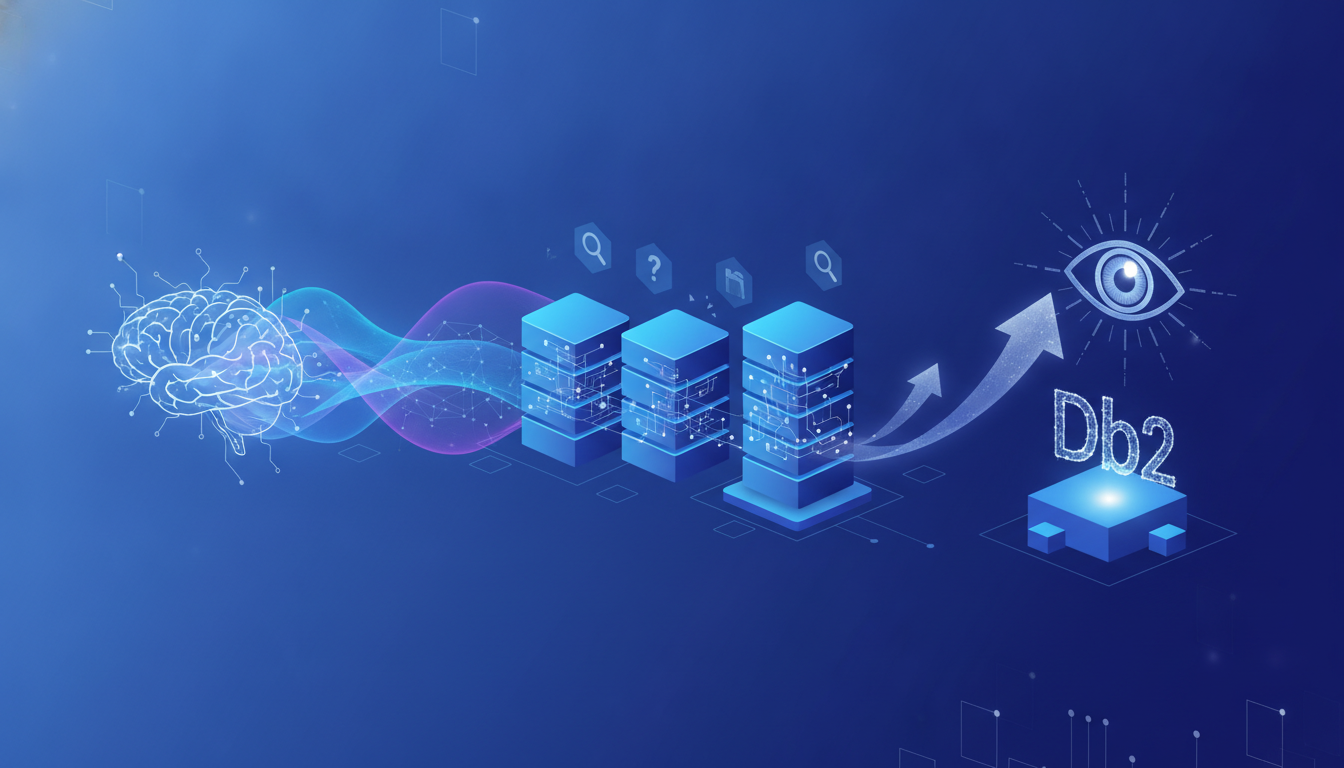
Semantic search is essential for bridging the gap between raw data and actionable insights. By embedding advanced semantic analysis directly into Db2, SQL DI Pro transforms how organizations interact with their data. This integration facilitates deeper understanding, reduces dependence on external processing pipelines, and simplifies compliance with data governance requirements.
Innovations of SQL DI Pro
Building upon the earlier foundations laid by SQL Data Insights, SQL DI Pro represents a significant leap forward in AI and data systems integration. One of its core innovations is the ability to convert structured relational data into dense vector representations. This transformation allows for similarity-based operations that traditional SQL queries cannot efficiently handle.
The capability to fully capture the semantic meaning of unstructured data is particularly noteworthy. A substantial amount of valuable information in enterprises resides in unstructured text fields—think customer notes, transaction descriptions, and compliance documents. SQL DI Pro employs advanced encoder models to generate high-quality embeddings for these long, complex text fields, enabling organizations to derive insights that were previously unattainable.
A Unified Approach to Data Insights
SQL DI Pro’s ability to unify structured and unstructured data is a game-changer for enterprises. By integrating semantic embeddings from both data types, it creates a cohesive semantic layer that allows for comprehensive analysis across diverse datasets.
The architecture consists of:
Column-level embeddings for unstructured data: Utilizing transformer-based encoders, long text columns are transformed into dense semantic vectors, capturing context and implicit relationships.
Structured data embeddings: Traditional tabular attributes are encoded using specialized models that maintain numerical relationships and categorical semantics.
Shared latent space: Both structured and unstructured embeddings are normalized and projected into a common vector space, enabling direct comparison and reasoning across different data modalities.
This unified framework empowers users to conduct AI-driven discovery, enhancing decision-making processes and operational efficiency.
Built-In Semantic Functions
SQL DI Pro introduces a suite of built-in SQL functions designed to streamline semantic analysis. By embedding these functions into SQL statements, users can seamlessly integrate advanced data processing into their workflows. This capability not only enhances the richness of data interactions but also democratizes access to sophisticated analytics across various user roles within an organization.
Continuous Adaptation with Incremental Model Training
One of the standout features of SQL DI Pro is its incremental retraining algorithm. Unlike traditional models that require full retraining upon the introduction of new data, SQL DI Pro allows for continuous updates to database embeddings. This reduces processing overhead and ensures that the system remains current with the latest data patterns, making it a robust solution for dynamic enterprise environments.
Accelerated Processing with AI Hardware
To further enhance performance, SQL DI Pro leverages the on-chip AI capabilities of IBM Z Telum processors. This innovative approach accelerates embedding generation and model inference, making semantic query processing practical for large enterprise datasets. By optimizing these workloads with the IBM Z Deep Learning Compiler, SQL DI Pro efficiently handles computationally intensive operations such as clustering and anomaly detection.
Conclusion
The future of AI-powered semantic search in IBM Db2 is set to redefine how enterprises engage with their data. With the capabilities introduced in SQL Data Insights Pro, organizations can look forward to a more intuitive, efficient, and compliant approach to data analysis. As data continues to grow in complexity and volume, the integration of AI within Db2 offers a promising path toward unlocking deeper insights and driving informed decision-making.
Saksham Gupta
Founder & CEOSaksham Gupta is the Co-Founder and Technology lead at Edubild. With extensive experience in enterprise AI, LLM systems, and B2B integration, he writes about the practical side of building AI products that work in production. Connect with him on LinkedIn for more insights on AI engineering and enterprise technology.