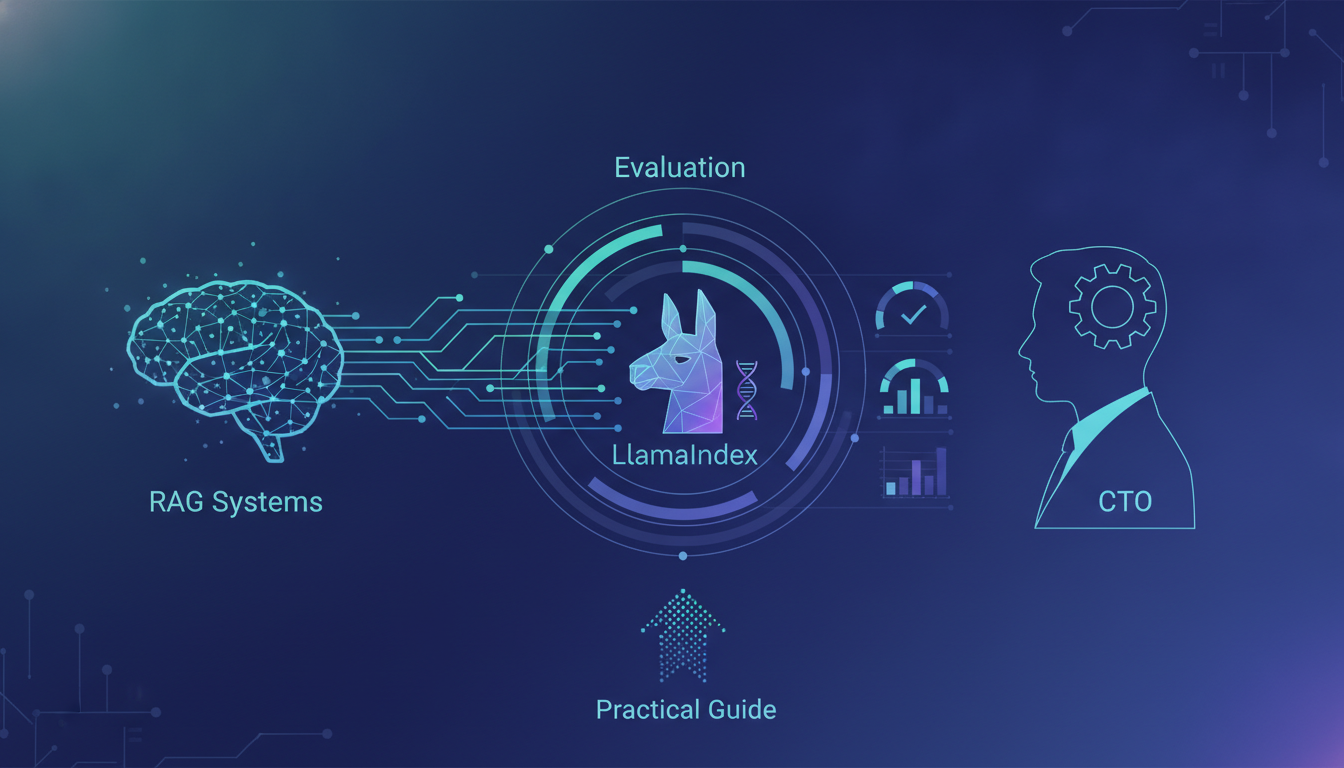
How to Evaluate RAG Systems: A Practical Guide for CTOs Using LlamaIndex
Hook: Addressing the Complexity of RAG Systems
As a CTO or an engineering lead, you’re likely grappling with the complexities of deploying Retrieval-Augmented Generation (RAG) systems in your enterprise. The challenge lies in effectively evaluating these systems to ensure they meet your organizational needs while integrating smoothly with existing technologies.
Answer-first Summary: The Path to Effective RAG Evaluation
To evaluate RAG systems effectively, focus on understanding the retrieval mechanism and response generation capabilities, especially when using tools like LlamaIndex. This involves assessing the system’s ability to fetch relevant information and generate accurate responses. By leveraging LlamaIndex’s capabilities, enterprises can optimize their RAG implementations, ensuring they align with business objectives and performance metrics.
What is Retrieval-Augmented Generation (RAG)?
Retrieval-Augmented Generation (RAG) systems combine the strengths of retrieval-based and generative models to enhance information processing. In an enterprise context, this means accessing the most relevant data from vast repositories and generating coherent responses. Understanding RAG involves dissecting two main components: the retrieval mechanism, which identifies pertinent information, and the generative aspect, which crafts responses. This dual approach is particularly beneficial for enterprises dealing with large datasets, where traditional methods may fall short in delivering quick and accurate information. For example, in our MoSPI RAG deployment, we tailored the system to handle complex statistical queries efficiently, demonstrating the practical benefits of RAG systems.
How Does LlamaIndex Facilitate RAG System Construction?
LlamaIndex serves as a pivotal tool in constructing RAG systems, offering a structured approach to integrate retrieval and generation processes. Enterprises can utilize its capabilities to streamline data indexing and retrieval, crucial for handling extensive datasets. When building a RAG system using LlamaIndex, the focus should be on leveraging its VectorStoreIndex, which allows efficient retrieval of relevant data points. This feature is particularly advantageous for enterprises like Cleo, where Zendesk RAG over support tickets required precise and efficient data handling. By structuring data effectively, LlamaIndex enhances the RAG system’s ability to deliver accurate and contextually relevant information.
Evaluating the Retrieval System: Key Metrics and Considerations
Evaluating the retrieval system within a RAG setup involves assessing its accuracy, speed, and relevance of the retrieved data. Key metrics include precision, recall, and latency. Precision measures the correctness of the retrieved documents, while recall assesses the comprehensiveness. Latency is critical in enterprise settings where real-time data retrieval is often necessary. For instance, in our work with Mohan Impex’s ERP system, optimizing retrieval speed was crucial for maintaining operational efficiency. Enterprises should conduct regular evaluations using synthetic datasets to simulate real-world scenarios, ensuring the retrieval system consistently meets performance benchmarks.
Assessing Response Generation: Ensuring Accuracy and Coherence
The response generation aspect of RAG systems is equally important, focusing on the quality of the generated responses. This involves evaluating coherence, context relevance, and accuracy. Enterprises need to ensure that the generative component aligns with their specific use cases, whether it’s customer support or data analysis. Using LlamaIndex’s capabilities, organizations can enhance the response generation process by training models on domain-specific data, ensuring responses are not only accurate but also contextually appropriate. This approach was crucial in our first-response automation for Cleo, where timely and precise responses were necessary.
How to Leverage Synthetic Data for Evaluation
Synthetic data plays a pivotal role in evaluating RAG systems, providing a controlled environment to test system capabilities. By generating question-context pairs, enterprises can simulate various scenarios to assess both retrieval and generation components. This method allows for comprehensive testing without the risks associated with using sensitive real-world data. In India, where data privacy is increasingly paramount, synthetic datasets offer a safe alternative for rigorous testing, ensuring compliance with data protection regulations.
Deployment Challenges in India’s Enterprise Landscape
Deploying RAG systems in India’s enterprise landscape presents unique challenges, including data localization requirements and integration with legacy systems. Enterprises must navigate regulatory landscapes while ensuring seamless integration with existing technology stacks. Our experience with on-premise LLM deployment highlights the importance of customizing solutions to meet local regulations and enterprise needs. By addressing these challenges, organizations can effectively deploy RAG systems that are both compliant and efficient.
What this Means for Your Organization
For enterprises considering RAG systems, the evaluation process is crucial for ensuring alignment with business objectives. By focusing on retrieval accuracy, response quality, and regulatory compliance, organizations can enhance their decision-making processes. Leveraging tools like LlamaIndex not only facilitates efficient RAG system construction but also ensures ongoing performance optimization. As enterprises in India continue to adopt AI solutions, understanding and implementing effective RAG evaluation strategies will be key to maintaining competitive advantage.
FAQ
What is the primary benefit of using LlamaIndex for RAG systems? LlamaIndex enhances the retrieval and generation processes, making it easier for enterprises to manage large datasets and generate accurate responses, crucial for maintaining operational efficiency.
How can synthetic data improve RAG evaluation? Synthetic data allows for comprehensive testing of RAG systems in a controlled environment, ensuring performance benchmarks are met without compromising sensitive data.
What considerations are there for deploying RAG systems in India? Enterprises must consider data localization laws and ensure integration with existing systems, customizing solutions to meet both regulatory and business needs.
Closing Call-to-Action
Ready to optimize your RAG systems? Contact us to discuss how EdubildAI can support your enterprise AI initiatives.
Saksham Gupta
Founder & CEOSaksham Gupta is the Co-Founder and Technology lead at Edubild. With extensive experience in enterprise AI, LLM systems, and B2B integration, he writes about the practical side of building AI products that work in production. Connect with him on LinkedIn for more insights on AI engineering and enterprise technology.